You’re on the highway with adaptive cruise control (ACC) engaged. The car ahead slows, and your car eases off too — smoothly, without you ever touching a pedal. A thought surfaces: right now, for the driver tailing you, are your brake lights on?
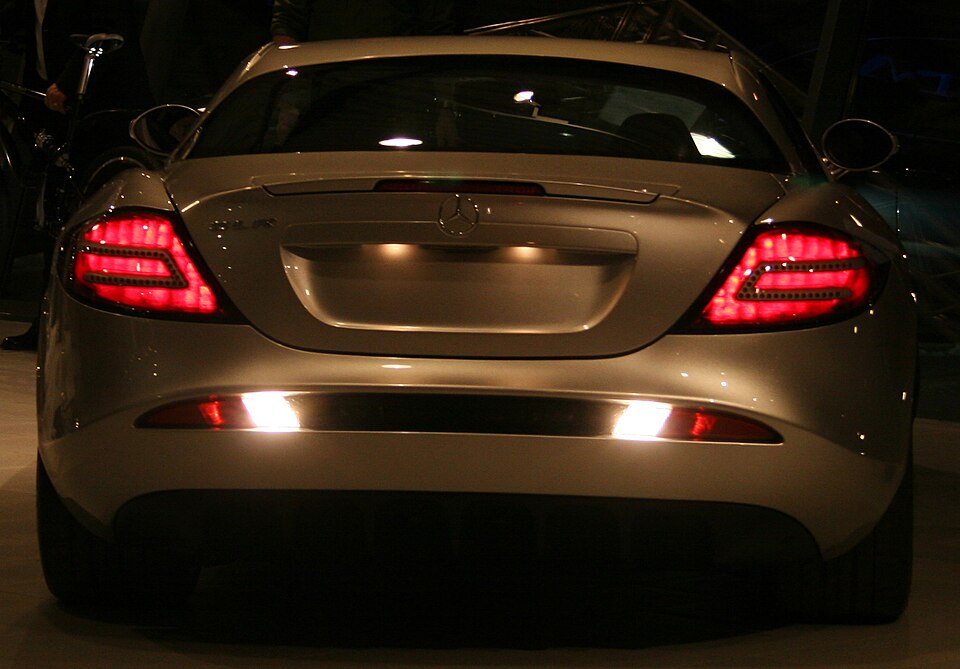

You didn’t press the brake, so maybe not. But notice the asymmetry: when you simply lift off the accelerator and let the car coast down, the lights clearly stay dark — yet when ACC actively reins the car in, the driver behind sometimes flinches as if they saw a brake light. Where exactly is the line between the two?
QUESTION
A brake light — the “stop lamp,” in regulatory language — is popularly understood as “the light that comes on when you press the brake pedal.” A switch behind the pedal closes, the lamp lights. Simple. And in the era of purely mechanical brake switches, that was exactly true.
Modern cars complicate it. ACC brakes hard enough to stop the car without the driver lifting a finger. The regenerative braking in EVs and hybrids — spinning the motor as a generator to recover kinetic energy as electricity — produces meaningful deceleration the instant you lift off the accelerator. Strong regen, the kind marketed as “one-pedal driving,” can bring the car to a near halt with the brake pedal untouched.
So the question sharpens to this: when the car slows itself without a pedal press, what is the precise criterion that decides whether the brake lights come on? And who sets it?
CHECK
The answer isn’t left to each automaker’s whim. It’s written, as a number, into international safety regulation.
The quantity that matters: deceleration
The deciding variable is not “was the pedal pressed” but deceleration — how fast speed is bleeding off:
where is the speed lost, the time taken, in m/s². To build intuition: drop from 60 mph to about 57 mph in one second and you’ve decelerated roughly 1.3 m/s².[9] Smaller changes than you’d guess sit right around 1 m/s².
The regulation: a line at 1.3 m/s²
UN Regulation No. 13-H, the international braking standard for passenger cars, handles stop lamps in two parts. First, when the driver applies the service brake (the ordinary brake pedal), the stop lamps shall illuminate.[1] So far, exactly the popular belief.
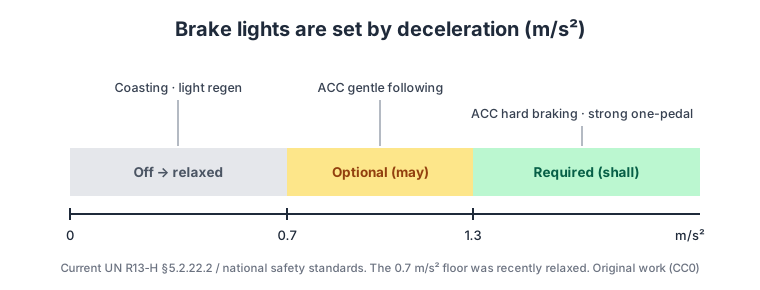
The interesting case is deceleration without the pedal — from regen or automated control like ACC. Paragraph 5.2.22.2 of the same regulation pins this down by deceleration:[2]
- Deceleration above 1.3 m/s² → the stop lamps shall be activated (mandatory).
- Deceleration at or below 1.3 m/s² → the stop lamps may be activated (the automaker’s choice).
What if you press the pedal? That’s separate
One thing is worth making explicit. The 1.3 m/s² threshold applies only when the car slows itself without a pedal press — regen, ACC, and the like. The brake pedal itself still carries a dedicated stop-lamp switch that senses the pedal moving and lights the lamps at once,[1] regardless of how much the car actually decelerates. A feather-light press that barely slows the car still lights the lamps, because what the switch registers is the pedal being touched, not the deceleration that follows.
EVs and hybrids didn’t delete this switch. The pedal switch stays, and the regen / automated-control logic — “light the lamps even without a pedal press, as long as the car slows hard enough” — is layered on top of it. So the two lighting paths run in parallel: press the pedal and the switch lights the lamps; slow hard without the pedal and the deceleration criterion does.
In the United States the governing rule is the federal standard FMVSS No. 108 rather than the UN text, but the backbone is the same: stop lamps illuminate on service-brake application.[7] National standards that follow the UN framework — Korea, the EU, and most of the world’s markets via the 1958 UNECE Agreement — carry essentially the 13-H wording.[3][5]
The vanished floor at 0.7 m/s²
Note the other line on the diagram: 0.7 m/s². For years the regulation also carried a lower floor. Below 0.7 m/s², the stop lamps shall not be activated — the logic being that a barely-there deceleration shouldn’t flash a stop signal and make the driver behind react to nothing.
So the old structure had three zones: below 0.7, lighting forbidden; 0.7 to 1.3, optional; above 1.3, mandatory. That floor was recently relaxed: across the entire range at or below 1.3 m/s², automakers may now choose to light the lamps.[2][4] As regen-braking vehicles proliferated, the change reflected a practical demand — the wish to signal the car behind even during gentle deceleration.
So what about ACC versus coasting?
Back to the opening question.
Lifting off the accelerator to coast relies on engine braking (or light regen), and on level ground that deceleration usually lands well under 1.3 m/s². It typically falls outside the mandatory zone, and automakers commonly tune it to leave the lamps off. That’s why lifting off “feels” like it never lights the brakes.
ACC, by contrast, brakes actively to hold a gap — and the moment its deceleration crosses 1.3 m/s², the lamps are required to come on. ACC systems are allowed to command up to roughly 3.5 m/s² of automatic deceleration under the ISO 15622 standard,[6] so a car ahead braking with any conviction routinely pushes past the line. Strong one-pedal driving is the same story: Tesla and others light the brake lamps once regen deceleration is large enough.[8]
FACT
The trigger for your brake lights isn’t one thing but two. Press the pedal and the pedal switch lights the lamps at once — no question of how hard you slowed. Slow without the pedal, and whether the lamps come on hinges on a single number: 1.3 m/s². ACC braking or one-pedal regen, cross that line and the regulation says the driver behind must be told. Coasting stays quiet because its deceleration usually never clears the threshold.
So “I didn’t brake, so the lights stay off” is only half true. Slow hard enough without the pedal and the lamps light anyway. That “hard enough” isn’t a vague feeling; it sits in paragraph 5.2.22.2 as a single number, 1.3. Once you also know that the old 0.7 floor beneath it quietly disappeared, you won’t be surprised when the EV ahead of you starts flashing its brake lights a little more often than it used to.
References
[1]: UN Regulation No. 13-H (Uniform provisions concerning the approval of passenger cars with regard to braking), para. 5.2.22 — stop lamps illuminate on service-brake application. EUR-Lex (CELEX 42023X0401). https://eur-lex.europa.eu/legal-content/EN/TXT/?uri=CELEX:42023X0401
[2]: Same regulation, para. 5.2.22.2 — for electric regenerative / automatically commanded deceleration, above 1.3 m/s² stop lamps shall be activated, at or below 1.3 m/s² they may be activated. EUR-Lex (CELEX 42023X0401).
[3]: Rules on the Performance and Standards of Motor Vehicles and Parts (stop-lamp provisions), Republic of Korea. Korea Law Information Center. https://www.law.go.kr/법령/자동차및자동차부품의성능과기준에관한규칙
[4]: Same rule, revision rationale — easing the EV regenerative-braking stop-lamp criterion from “may light above 0.7 up to 1.3 m/s²” to “may light at or below 1.3 m/s².” Korea Law Information Center. https://www.law.go.kr/LSW/lsRvsRsnListP.do?lsId=007939
[5]: UNECE 1958 Agreement (WP.29) and contracting parties — national vehicle standards harmonized with UN Regulations. UNECE. https://unece.org/transport/vehicle-regulations
[6]: ISO 15622:2018, Intelligent transport systems — Adaptive cruise control (ACC) systems — Performance requirements and test procedures (automatic deceleration limit ≈ 3.5 m/s²). https://www.iso.org/standard/71515.html
[7]: FMVSS No. 108 (Lamps, reflective devices, and associated equipment), 49 CFR 571.108. eCFR. https://www.ecfr.gov/current/title-49/subtitle-B/chapter-V/part-571/subpart-B/section-571.108
[8]: Tesla Model 3 Owner’s Manual — Regenerative Braking: brake lights illuminate when regenerative deceleration is sufficiently strong. https://www.tesla.com/ownersmanual/model3/
[9]: Unit conversion — 3 mph ÷ 2.237 ≈ 1.34 m/s; over one second ≈ 1.3 m/s². Deceleration defined as (author’s calculation).
[10]: “Tailing an EV and getting genuinely annoyed — here’s why” — discussion of regen-braking stop-lamp behavior and criteria. AutoHerald, 2023. http://www.autoherald.co.kr/news/articleView.html?idxno=50620