Ask an English speaker what a “dumpling” is, and you’ll get answers that don’t actually agree with each other. To one person it’s a potsticker stuffed with pork and cabbage. To another it’s the soft, doughy blob floating in a bowl of chicken and dumplings, with nothing inside it at all. To a third it’s a matzo ball, or the pastry-wrapped apple dessert their grandmother made. Merriam-Webster’s dictionary entry for “dumpling” quietly confirms that all three people are right: it lists a plain, unfilled ball of steamed or boiled dough as one sense of the word, and a pastry wrapping around fruit or meat as another, separate sense.[1] The single English word never bothered to distinguish “empty dough” from “stuffed dough” in the first place.
So when the same people walk into a Chinese restaurant and see mandu, gyoza, dim sum, and maybe an Indian samosa mentioned in the same breath, it’s no surprise they assume these are just regional spellings of one dish. Surely there’s some underlying test — filling, wrapper, cooking method — that would let you sort all of them onto a single scale. This article isn’t going to propose that test. Trace each of these four words back through dictionaries, food regulations, and old texts, and you run into a different problem entirely: these words were never naming the same kind of thing to begin with. Some name a dish. One names an entire style of eating. And in one especially stubborn case, the identical two characters point at opposite foods depending on which country you’re standing in. Before asking “what’s the rule that separates them,” it’s worth checking whether these four words even belong on the same line.
QUESTION
Line up mandu, gyoza, and dim sum on a menu and it’s tempting to assume they’re regional variations of one dish, sortable by some single axis — dough type, cooking method, whether there’s a filling. But are these four things actually comparable in the first place? The moment dim sum gets placed next to mandu and gyoza as if it were a peer, is a category error already happening? And here’s a sharper test: does the Korean word “mandu,” written with the Chinese characters 饅頭, point at the same food in Chinese as it does in Korean? Korean absorbed a large share of its vocabulary from Chinese characters (hanja) centuries ago, much as English absorbed Latin and French roots — so it’s a fair question whether a loanword kept its original meaning intact. Let’s check each claim against a primary source.
CHECK
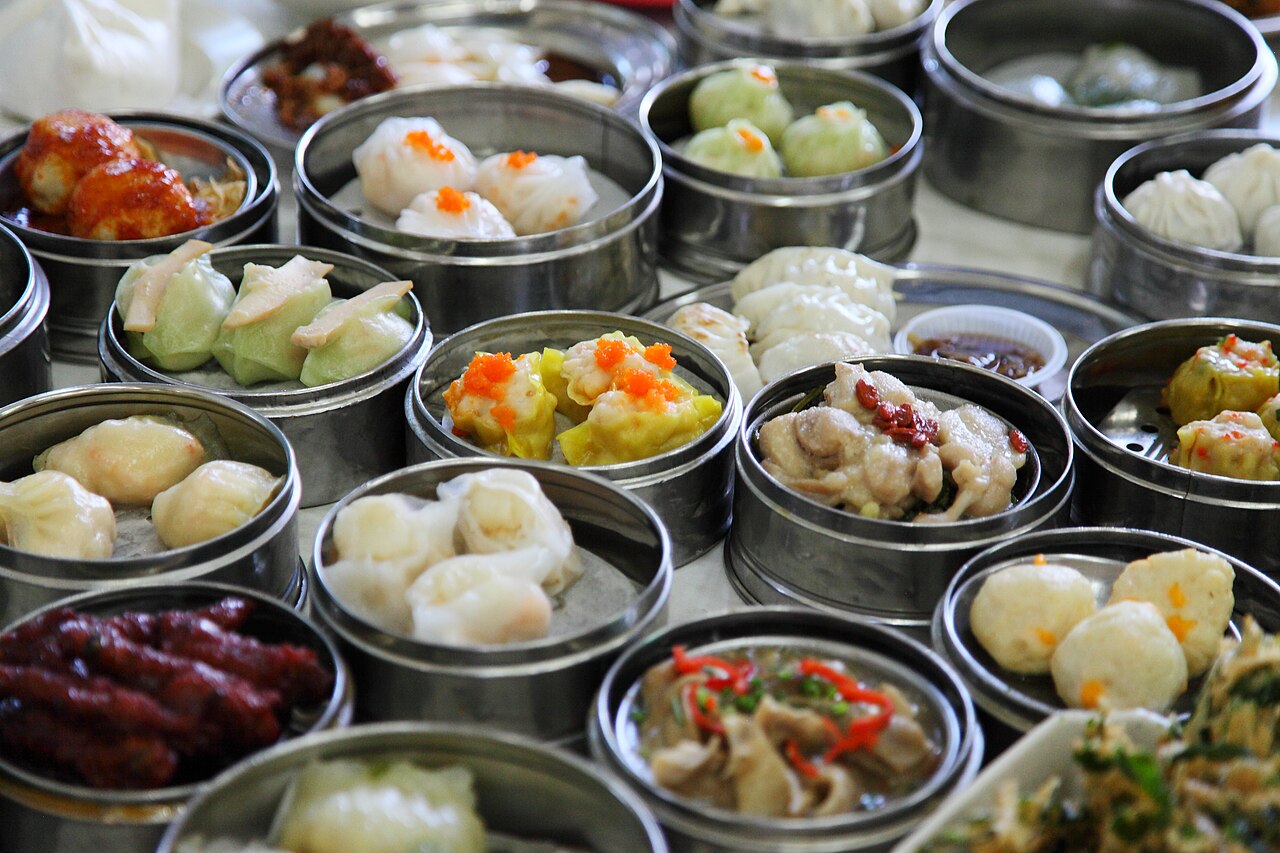
Dim sum isn’t a cousin of dumplings — it’s the category that contains some of them
Start with dim sum (點心, dim sum). The Encyclopaedia Britannica defines it as an umbrella term for a wide variety of appetizer-style dishes believed to have originated in Cantonese cuisine.[2] In Cantonese restaurants, Britannica notes, dim sum is traditionally the snack-and-tea service offered in the morning and at midday, and the name itself comes from a Cantonese phrase meaning something like “to touch the heart” or “a little bit of heart” — a light bite to whet the appetite.[2]
The important detail is that dim sum is not the name of one dish. Dumpling-type items like har gow (shrimp dumplings) and siu mai (pork dumplings wrapped in a thin skin) are certainly part of dim sum, but so are cheung fun (rice-noodle rolls), egg tarts, congee, and braised spare ribs — none of which have anything to do with a dumpling. Dim sum, in other words, isn’t an “item,” it’s a “meal format.” It names the occasion — small dishes shared over tea — not any one food served at that occasion.
Miss this distinction and “is it mandu or is it dim sum” stops being a question that can even be answered. It’s a bit like asking, “Is this person a student, or are they a third-grader?” Third grade is a subcategory of being a student, not a competing option. In the same way, har gow is a line item under dim sum, not a rival category to be weighed against mandu on a scale. If you want something to compare against mandu, the fair comparison is har gow or siu mai individually — not the entire dim sum format.
.jpg)
The two characters 饅頭 split into opposites
This is where the article’s real hinge sits. Korean “mandu” is a direct borrowing of the Chinese characters 饅頭. South Korea’s National Institute of Korean Language, in its Standard Korean Dictionary, defines mandu as “a food made by kneading flour or a similar ingredient into dough and shaping it around a filling.”[3] By this definition, a filling — meat, vegetables, something chopped and stuffed inside — is not optional. It’s the whole point.
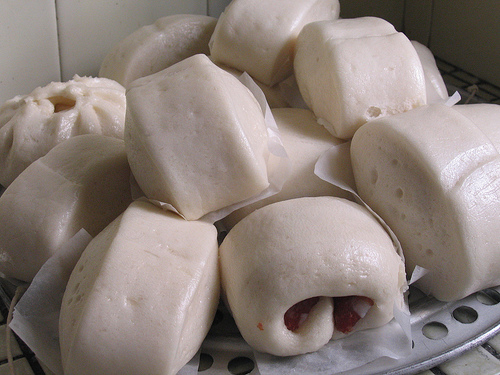
Standard Mandarin Chinese (普通話) uses the same two characters, 饅頭 (mántou), to mean exactly the opposite. The online Chinese dictionary Zdic (漢典), in its entry for 馒头, describes it as a steamed food made from fermented wheat dough, and adds that in today’s usage in northern China, the unfilled version is called mántou while the filled version gets its own separate name: 包子 (bāozi).[4] The same dictionary’s entry for 包子 confirms the split from the other side — bāozi is dough shaped around a filling and then steamed, a term that has been in use since the Song dynasty.[5] Put the two together and the picture is stark: Korean “mandu” requires a filling. Standard Mandarin “mántou” requires the absence of one. The same two characters are attached to opposite objects in the two languages.
Chinese historical sources show how this reversal happened. The Southern Song official Wang Yong (王栐), in his record 燕翼詒謀錄 (Yànyì Yímóu Lù), reportedly described the emperor Renzong gifting bāozi to his officials on his birthday, then added a note — quoted by multiple independent Chinese-language outlets — to the effect that “this is simply another name for mántou; today, common usage calls anything made of fermented wheat dough and steamed ‘mántou,’ whether or not it has a filling.”[6] If that quotation is accurate, it means that as of the Southern Song, 饅頭 and 包子 hadn’t yet split into two firmly distinct words — there was a broader, older usage in which “mántou” covered any steamed fermented dough, filled or not, regardless. One limit is worth stating plainly: the passage here has not been checked against the original text. It rests on a secondary citation — several independent Chinese-language outlets quoting the identical wording — and should be read with that in mind.[6]
The split into two separate words took longer to settle than that one quotation suggests. According to an article from the Chinese popular-science outlet Guokr (果殼) that surveys several historical texts, after the Yuan dynasty the center of gravity of “mántou” gradually shifted from filled to unfilled, and it wasn’t until the Qing dynasty that “unfilled steamed bun” became firmly established in the written record, effectively completing the mántou/bāozi split.[7] The late-Qing compiler Xu Ke’s (徐珂) sprawling compendium of social history, 淸稗類鈔 (Draft Classified Anecdotes of the Qing), is frequently cited elsewhere as a record of regional usage differences from this period, but that passage, too, has not been checked against the original text here. What the same Guokr article does confirm directly, quoting Qing-era sources it accessed separately, is that even after the northern split — unfilled = mántou, filled = bāozi — the Wu-dialect region (吳語, the area around the lower Yangtze/Jiangnan) kept the older, broader usage, calling both filled and unfilled versions “mántou” regardless.[7] (Whether this regional pattern extends beyond the Wu-dialect area to southern China more broadly is not established here.) So what actually settled during the Qing dynasty wasn’t a single, universal answer of “mántou means unfilled” — it was two different regional conventions existing side by side.
Where did Korean usage land in all this? It’s difficult to pin down the exact route or moment the word entered Korean from written sources alone. But going by the outcome, Korean “mandu” sits closer to the older, broader usage — the one where a filling doesn’t disqualify something from being called mántou — rather than the narrower sense that later hardened in northern Mandarin. The result is that a mandu ordered in Seoul today is packed with meat and vegetables, while a mántou ordered in Beijing today, in standard Mandarin, is a plain, hollow white steamed bun — the reverse of Seoul’s version. Same characters. Opposite object.

Gyoza isn’t the Japanese word for mandu — it’s defined on an entirely different axis
So where does Japanese gyoza (餃子) fit? It’s commonly described as “the Japanese version of a fried mandu,” but open a dictionary and gyoza was never defined by whether it has a filling or how it’s cooked in the first place. Kotobank (コトバンク), the Japanese reference search service that hosts Shogakukan’s Digital Daijisen dictionary, defines gyoza as “one of the dim sum dishes of Chinese cuisine: minced pork and finely chopped vegetables wrapped in a thin sheet of kneaded wheat dough, shaped into a half-moon, and then pan-fried, steamed, or boiled.”[8]
Break that definition down and gyoza is defined by exactly two things: the type of dough, and the finished shape. Zdic’s entry for 饺子 (jiǎozi) gives essentially the same outline — a thin wrapper folded around a filling into roughly a half-moon or triangle, then boiled, steamed, or pan-fried.[9] The dough is unleavened wheat dough, mixed with cold water (referred to in Chinese as 冷水麵 or 死麵, “dead dough” that hasn’t been fermented). The shape is a half-moon. Cooking method — boiling, steaming, frying — isn’t part of the definition at all; it’s just a modifier tacked on afterward. Chinese usage makes this explicit: boiled is 水餃子 (shuǐjiǎozi), pan-fried is 煎餃子 or 鍋貼 (jiānjiǎozi / guōtiē), steamed is 蒸餃子 (zhēngjiǎozi) — in each case, the prefix names the cooking method while 餃子 itself stays fixed. The common assumption that “gyoza equals fried mandu” mistakes one cooking method among several for the definition of the whole category.
This is where the article’s central point about mismatched levels comes into full view. The axis that separates 饅頭 from 包子 is “does it have a filling or not.” The axis that defines 餃子 is “what dough, shaped how.” These are two completely different rulers. Asking “which came first, mandu or gyoza” isn’t comparing two points on the same axis — it’s closer to comparing two numbers measured with different instruments entirely.
The Silk Road single-origin theory: where the evidence actually stops
A reasonable objection at this point: didn’t all of this spread from one common ancestor along trade routes like the Silk Road? Thin dough wrapped around a filling and cooked shows up across Eurasia, so a single point of origin sounds plausible on its face. But the honest position here is neither to confirm nor to rule it out. “Wrap a filling in thin dough and apply heat” is also a simple enough idea that separate societies growing wheat and using ovens or steamers could plausibly have arrived at it independently, without ever being in contact. No decisive text or archaeological link establishes a single common origin — and nothing rules out independent, parallel invention either. This is the honest limit of what can be said here: the names and definitions clearly sit on different levels from each other, but whether they share one ancestor or many remains an open question.
Samosa: quite possibly a different lineage altogether
The samosa, eaten across India, the Middle East, and South Asia, needs to be set aside from mandu, gyoza, and dim sum before any comparison is made, because its lineage may be different from the start. The Oxford Companion to Food — a standard reference work in food history — entry on “samosa” (written by Charles Perry and Helen Saberi) traces the name to the Persian sanbosag, first appearing in Arabic-language cookbooks from the 10th to 13th centuries under spellings like sanbusak, sanbusaq, and sanbusaj.[10] In other words, the samosa may belong to a Persian-language lineage entirely separate from the East Asian dough-and-filling tradition that produced mántou/bāozi and jiǎozi. It’s a reminder that other foods with a similar surface appearance — ravioli, pierogi, empanadas — may likewise have grown from entirely separate roots despite the shared “dough wrapped around a filling” silhouette. This article won’t extend that list any further.
Customs codes and food-safety labels answer a different question than the culinary one
One more layer is worth a brief mention: the administrative one. Internationally, the World Customs Organization’s Harmonized System (HS) assigns dumpling-type foods a single shared six-digit code, 1902.20, “Pasta, stuffed with meat or other substances, whether or not cooked.”[11] Individual customs territories then add their own extensions on top of that shared base — and this is where the often-cited “20% meat by weight” rule actually lives. The European Union’s Combined Nomenclature (CN), for instance, extends 1902.20 further to distinguish products where meat or fish content exceeds 20% by weight from those that don’t.[11] South Korea’s customs office, by contrast, applies a single undifferentiated code — 1902.20-0000 — to frozen mandu in its own classification table (HSK), with no such split at all.[11] So even a seemingly precise figure like “20%” isn’t a universal standard shared worldwide; it’s a regional convenience rule that some customs systems apply and others simply don’t bother with.
South Korea’s food-safety code offers a different kind of administrative label worth noting as one national example. The Korean Ministry of Food and Drug Safety’s Food Code defines the food category “mandu-ryu” (만두류, “mandu-type products”) as “a molded combination of meat, vegetables, and similar ingredients formed using a mandu wrapper or equivalent.”[12] Notice that this definition sorts by shape, not ingredients. Industry sources suggest that a product using a tofu-skin wrapper instead of a wheat wrapper could still qualify as “mandu-type” under this wording, though no official ministry ruling or notice confirming that specific interpretation could be found. What the text of the regulation itself does clearly show is that it draws the line at “something shaped around a filling,” leaving the door open for non-wheat wrappers to count administratively as mandu.
Even which broader category this definition sits under has shifted over time. According to a trade-press report, as of early 2026 the ministry had prepared a research report proposing a large-scale overhaul of the Food Code, targeting a 2026 pre-announcement, a 2027 official notice, and full implementation by 2030 — and that overhaul reportedly considered eliminating the “mandu” food category altogether, folding it into a broader “ready-to-cook foods” category.[13] The same report states that, after requests from industry and experts describing mandu as “a flagship K-food item representing a market worth roughly ₩1 trillion (about $750 million as of early 2026 exchange rates),” regulators decided to keep the mandu-type category intact.[13] The timeline for this overhaul is independently confirmed in an official ministry planning document, but the specific claims about mandu’s category being on the chopping block and the ₩1 trillion market figure rest solely on the trade-press report and are not independently confirmed by any official ministry document.[13] Either way, the fact that mandu’s administrative box keeps getting redrawn across revisions is itself a reminder: this classification isn’t a culinary answer to “what is mandu,” it’s a paperwork convenience that shifts with each regulatory cycle.
FACT
Mandu, gyoza, dim sum, and samosa are not different regional names for the same lineage of food. They were never pointing at the same level of thing to begin with. Dim sum is a meal format, not an item. The two characters 饅頭 point at opposite fillings-or-not depending on whether you’re reading Korean or standard Mandarin. Gyoza is defined by dough and shape, not by filling. And samosa may trace to an entirely separate, Persian-language lineage. Sorted out, here’s what each name actually refers to:
| Name | What it actually refers to |
|---|---|
| Dim sum (點心) | Not a single dish, but a meal format built around small dishes shared over tea. Dumpling-type items like har gow and siu mai are only some of what’s served |
| Mandu / mántou (饅頭) | Korean: dough wrapped around a filling / Standard Mandarin (north): unfilled steamed bun (filled versions are called 包子/bāozi instead) / Wu-dialect Chinese (Jiangnan region): both filled and unfilled versions called by the same name |
| Gyoza / jiǎozi (餃子) | Unleavened, cold-water dough rolled thin and shaped into a half-moon. Boiling, frying, and steaming are prefixes attached to the name, not part of the definition itself |
| Samosa | Traces to the Persian sanbosag — possibly a lineage entirely separate from East Asian dumpling-type foods |
The most ironic case is the two characters 饅頭 themselves. Not a single stroke changed as the word crossed a border, and yet what sat inside it kept flipping on and off. Southern Song sources called something “mántou” even with a filling inside. Qing-dynasty northern Chinese usage started giving filled versions a different name (包子) altogether. Korean carried over the meaning from before that split ever happened. The upshot: someone biting into mandu in Seoul and someone biting into mántou in Beijing are saying the identical two Chinese characters out loud, while one of them is chewing meat and vegetables and the other is chewing plain wheat dough.
References
[1]: Merriam-Webster, “Dumpling,” Merriam-Webster.com Dictionary, https://www.merriam-webster.com/dictionary/dumpling — lists both an unfilled, steamed-or-boiled mass of dough and a filling wrapped in dough or pastry as separate senses of the same English word.
[2]: Encyclopaedia Britannica, “Dim sum,” Encyclopaedia Britannica Online, https://www.britannica.com/topic/dim-sum
[3]: National Institute of Korean Language (국립국어원), Standard Korean Dictionary (표준국어대사전), entry “만두” (“a food made by kneading flour or a similar ingredient into dough and shaping it around a filling”), https://stdict.korean.go.kr/search/searchResult.do?pageSize=10&searchKeyword=만두
[4]: Zdic (漢典, zdic.net), entry “馒头,” https://www.zdic.net/hans/馒头 — confirms the modern standard Mandarin usage in which the unfilled steamed version is called mántou, while the filled version is given the separate name bāozi (包子).
[5]: Zdic (漢典, zdic.net), entry “包子,” https://www.zdic.net/hans/包子 — describes dough shaped around a filling and steamed, and notes this term has been used since the Song dynasty.
[6]: Wang Yong (王栐, Southern Song), 燕翼詒謀錄 (Yànyì Yímóu Lù), the passage in question (“仁宗誕日, 賜群臣包子, 即饅頭別名. 今俗屑麵發酵, 或有餡, 或無餡, 蒸食者謂之饅頭.”) as quoted identically by multiple independent Chinese-language outlets, including CNR (央廣網), “舌尖上的考古:包子、馒头 古人傻傻分不清” (2017), http://edu.cnr.cn/list/20170328/t20170328_523680269.shtml, and Cankao Wang (參考網), “馒头、包子名称所指及演变” (2021), https://m.fx361.com/news/2021/0615/8464404.html. The original text has not been consulted directly, so this account rests on secondary citation rather than a firsthand reading.
[7]: Guokr (果殼), “啥?馒头有馅?我才不信你的邪!,” https://m.guokr.com/article/456185/ — confirms, from the original text, both the claim that “mántou” gradually shifted from filled to unfilled after the Yuan dynasty (with the mántou/bāozi split settling during the Qing), and the regional-usage note: “北方称无馅的为馒头,有馅的为包子,但吴语区沿袭旧习,有馅没馅儿的统称’馒头’” (the north calls the unfilled version mántou and the filled version bāozi, but the Wu-dialect region follows the older custom and calls both filled and unfilled versions “mántou”). This article confines that regional difference explicitly to the Wu-dialect (吳語) area and does not generalize it to southern China as a whole. The late-Qing compiler Xu Ke’s (徐珂) compendium 淸稗類鈔·飮食類 is frequently cited elsewhere as documenting regional usage differences from this period, but that passage has not been verified against the original text here.
[8]: Kotobank (コトバンク), Shogakukan’s Digital Daijisen (小学館「デジタル大辞泉」), entry “餃子,” https://kotobank.jp/word/餃子-479204
[9]: Zdic (漢典, zdic.net), entry “饺子,” https://www.zdic.net/hans/饺子
[10]: Charles Perry and Helen Saberi, “Samosa,” in Alan Davidson (ed.), The Oxford Companion to Food, Oxford University Press, via Oxford Reference, https://www.oxfordreference.com/display/10.1093/acref/9780199677337.001.0001/acref-9780199677337-e-2126
[11]: World Customs Organization (WCO), Harmonized System (HS), heading 1902.20, “Pasta, stuffed with meat or other substances, whether or not cooked.” The 20%-by-weight meat-content threshold is not part of this shared six-digit international code; it appears only in the further 8–10 digit extensions that individual customs territories add on their own, such as the European Union’s Combined Nomenclature (CN) subheading 1902.20.30 (meat/sausage content exceeding 20%) — European Commission, Taxation and Customs Union, “Combined Nomenclature,” https://taxation-customs.ec.europa.eu/customs/calculation-customs-duties/customs-tariff/combined-nomenclature_en. By contrast, the code South Korea’s customs authority applies to frozen-mandu trade statistics — the Korea Customs and Trade Development Institute’s classification table (HSK) — is a single undifferentiated code, 1902.20-0000, with no such split — Korea Customs Service, CLIP (Customs Law Information Portal), https://unipass.customs.go.kr/clip/hsinfosrch/openULS0201002Q.do.
[12]: Ministry of Food and Drug Safety (식품의약품안전처), Food Code (식품공전, “Food Standards and Specifications”), definition of the food category “만두류” (“mandu-type products”: “a molded combination of meat, vegetables, and similar ingredients formed using a mandu wrapper or equivalent”), https://www.foodsafetykorea.go.kr/foodcode/ — which specific chapter or subheading of the Food Code currently houses this definition has shifted across revisions, and the exact current clause number could not be established, so only the definition text itself is quoted here. The broader category this sits under has itself been restructured repeatedly — for example, the parent category “breads or rice cakes” was once split into six food types (bread, cakes, doughnuts, rice cakes, etc.) before being consolidated into three (breads, rice cakes, mandu-type products) — confirming that the administrative box housing mandu-type products has been redrawn multiple times through revisions. This category structure may change again under the Food Code’s comprehensive revision roadmap (2026–2030)[13].
[13]: Food News (foodnews.co.kr), “[Exclusive] Food Code overhaul in final research report… paradigm shift from ‘quality’ to ‘safety’,” Jan. 21, 2026, https://www.foodnews.co.kr/news/articleView.html?idxno=116942 — confirms a long-term roadmap targeting a 2026 pre-announcement and 2027 official notice ahead of full implementation in 2030; an original proposal to eliminate the “mandu” food category and fold it into ready-to-cook foods that was reversed after requests from industry and experts; and a cited market size of roughly ₩1 trillion (about $750 million at early-2026 exchange rates). The roadmap’s implementation timeline and the ministry’s general commitment to a comprehensive Food Code revision are independently confirmed in Ministry of Food and Drug Safety, “2026 Key Policy Implementation Plan” (2026년 주요업무 추진계획), Dec. 16, 2025, https://www.mfds.go.kr/files/upload/etc/2026_mfds_1.pdf. However, the specific details about the mandu category’s survival and the ₩1 trillion market figure are not confirmed by any official ministry document and rest solely on Food News’s exclusive report.