In the climactic sequence of 2001: A Space Odyssey (1968), astronaut Dave Bowman is stranded outside the Discovery One in a pod with no helmet, and has to cross open vacuum to reach the ship’s emergency airlock. His plan, in the seconds before exposure: take one enormous breath and hold it. It’s the same instinct almost anyone would have — space is the coldest place imaginable, so brace for the cold and hang on.
Except that’s not quite the danger vacuum actually poses. Before we get to Bowman’s lungs, it’s worth re-examining the premise underneath the scene: the idea that “space is near absolute zero, so exposure means flash-freezing.”
QUESTION
Vacuum is genuinely dangerous — nothing here argues otherwise. But the specific danger people picture, sudden freezing, deserves a closer look. A vacuum has no air and no water in it, which means it has no medium to carry heat through. So how does an object in vacuum actually lose or gain heat? And is that process anything like the “cold” we’re used to on Earth?
Answering that means going back to the basic physics of how heat moves — and it turns out that one principle explains why the International Space Station hauls around a heavy-duty cooling system, why spacesuit engineers worry about overheating rather than frostbite, and why Google recently named cooling as the single hardest problem in its plan to put data centers in orbit. By the end, we’ll circle back to Bowman, mid-breath, about to jump.
CHECK
Two ways to lose heat disappear in vacuum. One doesn’t.
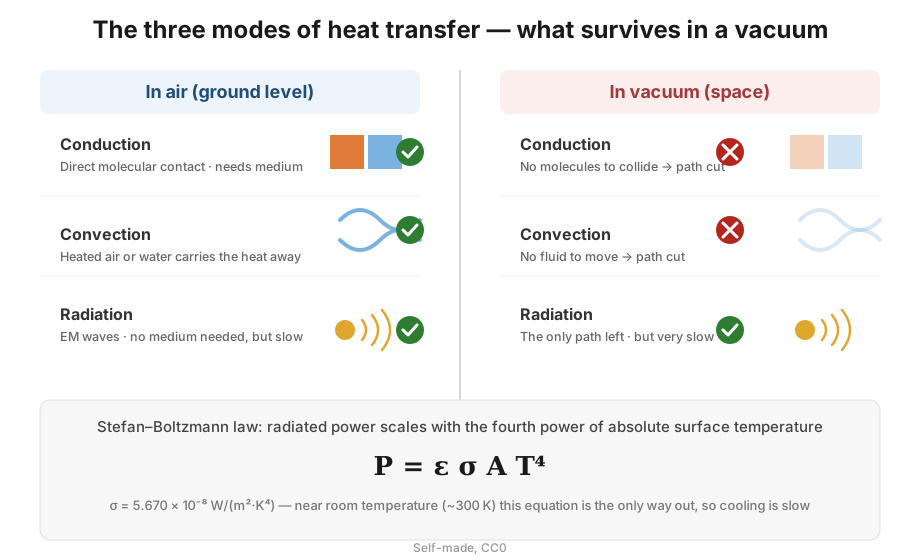
Physics recognizes three ways heat moves from one place to another. Conduction is molecules in direct contact passing vibration to each other; convection is a heated fluid — air or water — physically carrying that heat away as it moves. Both require a medium: some material for the heat to travel through.[1]
Radiation is different. Any object warmer than absolute zero emits energy as electromagnetic waves, and those waves propagate whether there’s air around them or nothing at all. In a vacuum, there’s no material to carry conduction or convection, so both are shut off completely. Radiation is the only path left.[1]
The catch is that radiation is slow. The rate at which an object sheds heat by radiation follows the Stefan–Boltzmann law:
Here is power radiated (in watts), is the surface’s emissivity (0 to 1, with a perfect blackbody at 1), is surface area (), and is absolute temperature (K). is the Stefan–Boltzmann constant, .[2] For an object near room temperature — a human body or a piece of electronics at roughly — the term doesn’t amount to much in absolute terms. Take a pot off the stove and let it cool by convection and conduction in open air, then compare that to the same pot cooling by radiation alone in vacuum: the vacuum case is dramatically slower, because air’s convection is an efficient heat courier and vacuum has none.
The exponent is what does the work here. Double the absolute temperature and the emitted power goes up by — a factor of 16. A surface at 300 K radiates a mere 459 watts per square meter; at 1,000 K it radiates close to 57,000.[2] Something glowing red-hot sheds heat ferociously; something merely lukewarm barely sheds it at all.
And the heat a spacecraft needs to dump is, almost by definition, produced at temperatures people and electronics can survive — which is to say, right around room temperature. That is precisely where radiation is at its feeblest. Since the area needed to shed a given amount of heat scales as the inverse fourth power of absolute temperature, running a radiator at 350 K instead of 300 K would cut the required area nearly in half. This is why thermal design for spacecraft aims not at “keep everything as cold as possible” but at “collect the waste heat as hot as you can before throwing it overboard.” Heat only flows downhill from hot to cold, of course, so there is a ceiling on how hot a radiator can run. The radiators on the ISS are what that tug-of-war produces.
This is also the moment to unpack the claim that “space is 2.7 K (about −454°F / −270°C), so it’s cold.” That number is the blackbody temperature of the cosmic microwave background (CMB) — the residual glow of the early universe, cooled by billions of years of expansion.[3] But vacuum itself has no material to hold heat and no body to feel a temperature. An object’s actual temperature is set not by “how cold space is” but by radiative equilibrium: the balance between the radiation it absorbs (from the Sun, say) and the radiation it emits on its own.[3] That’s why a satellite surface facing the Sun can exceed 212°F (100°C), while its shaded side can drop below −148°F (−100°C). “Space is cold” is a sentence that can’t hold both of those facts at once.
Why the ISS hauls a 70 kW cooling system into orbit
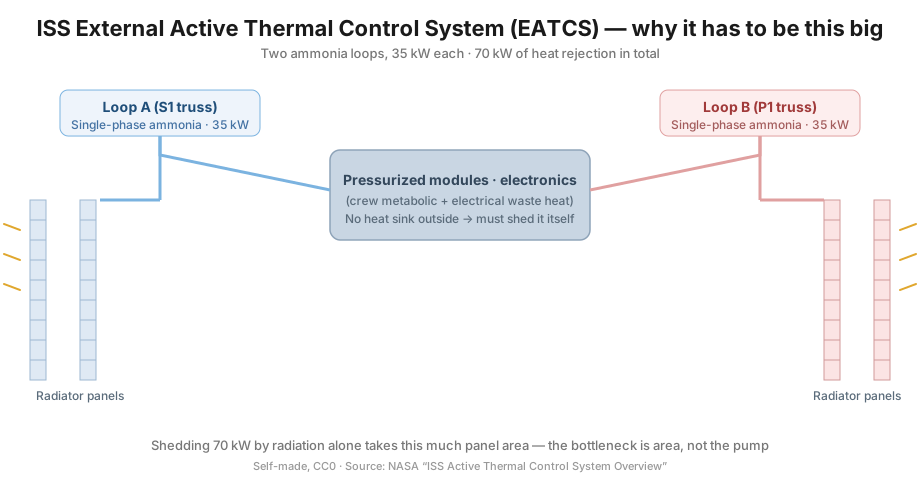
How much of an engineering burden “radiation is slow” actually becomes is obvious once you look at the International Space Station. Crew metabolism and onboard electronics generate heat continuously, and radiation is the only way to get rid of it. NASA runs a system for exactly this called the External Active Thermal Control System (EATCS): two single-phase ammonia pump loops — Loop A on the S1 truss, Loop B on the P1 truss — each rated for up to 35 kW, for a combined radiating capacity of 70 kW.[4] Ammonia absorbs heat from equipment inside the station, then flows out to large external radiator panels, where that heat finally leaves as radiation.
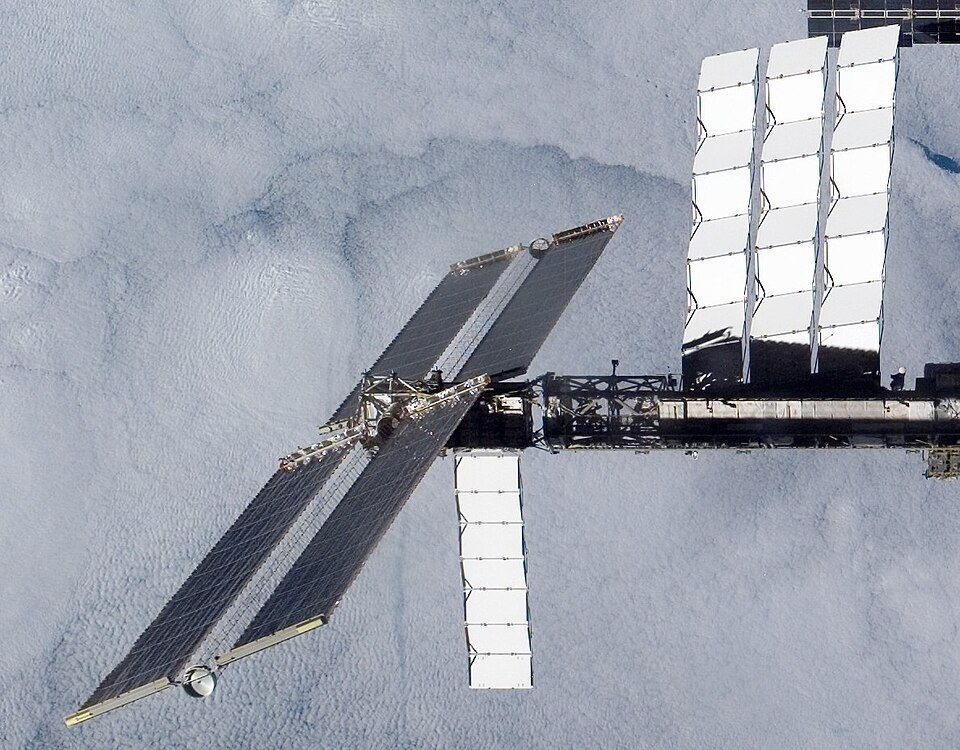

70 kW is roughly what a few dozen American homes draw at once. To shed that much heat, the ISS has to unfold multiple large radiator panels along its truss. The station is often described as “the size of a football field,” but that figure refers to the full length of the truss plus solar arrays (about 109 m / 358 ft end to end), not the radiators themselves. Still, the fact that dedicated panels — far larger than the pressurized modules they’re attached to — are needed just to dump 70 kW says something on its own: radiative cooling is dramatically less efficient than convection or conduction. Inside Earth’s atmosphere, convection alone could shed the same heat load with equipment a fraction of the size. The ISS’s cooling hardware is enormous not because the crew is at risk of freezing, but for the opposite reason — heat has nowhere to go on its own.
The real enemy of a spacesuit isn’t cold — it’s overheating
Spacesuits run into the same problem. During a spacewalk (EVA), astronauts wear a form-fitting undergarment inside the suit called the Liquid Cooling and Ventilation Garment (LCVG) — a mesh of thin tubing that absorbs metabolic heat from the skin into circulating water.[5]
That warmed water then flows to a sublimator inside the backpack-mounted life support system (PLSS, Portable Life Support System). The sublimator is a porous, sintered nickel plate: one face touches the water loop, the other is exposed directly to vacuum. On the vacuum side, water freezes into the plate’s microscopic pores, and that ice sublimates — turns straight from solid to gas — into space. Sublimation absorbs a large amount of latent heat, which pulls heat out of the water on the other side of the plate. The rate of cooling is self-regulating, tied automatically to how much ice sublimates, with no moving parts required.[5]
What that design tells you is unambiguous. Spacesuit engineers aren’t worried about hypothermia — they’re worried about heat buildup. Because vacuum is bad at pulling heat away, the metabolic heat a body generates plus the radiant heat hitting a sunlit suit exterior would turn the suit into an oven if left unmanaged. The suit’s thermal system is a cooler, not a heater, and its key component isn’t called a “warmer” — it’s called a sublimator.
Orbital data centers: not “free cooling,” but the opposite problem
The same principle just showed up in industry. On November 4, 2025, Google unveiled Project Suncatcher, a research effort to put AI data centers into orbit — solar-powered satellites carrying its own TPU compute chips to run workloads directly in space, in partnership with Planet Labs, with two prototype satellites planned for launch in early 2027.[6]
And cooling is one of the biggest challenges Google itself flagged when announcing the project. Ground-based data centers can lean on water- or air-based convective and conductive cooling; in orbit, neither option exists. Google describes orbital cooling as dependent on “pure radiative cooling, without pumps or water,” and says the heat-transport hardware moving heat from chip to radiator has to be designed to be as passive as possible for reliability.[6] The expectation that “space is cold, so cooling will be free” runs backward — cooling turns out to be one of the biggest obstacles to putting a data center in orbit at all. Around the same time, Starcloud, a startup that actually launched a satellite carrying an Nvidia H100 chip (StarCloud-1), used phase-change immersion cooling on its first model but found it didn’t scale; later models are shifting to deployable radiators instead.[7]
“Won’t freeze to death” doesn’t mean “won’t feel cold”
There’s an easy place to get confused here. Everything above shows that radiation alone doesn’t crash an object’s overall temperature quickly — it does not mean that exposed body tissue feels nothing. Those are two separate claims.
Drop pressure low enough and water’s boiling point drops with it. Above roughly 63,000 ft (about 19 km, where pressure hits 6.3 kPa), water boils at normal body temperature (98.6°F / 37°C). Aerospace medicine calls this altitude the Armstrong limit.[8] Vacuum sits far beyond that threshold, so any exposed moisture — on skin, in the mouth, on the surface of the eyes — vaporizes rapidly. Vaporization requires heat, so it pulls heat locally out of that tissue; people briefly exposed to vacuum have reported the sensation of saliva or tears seeming to boil, accompanied by a cold feeling.[8]
NASA’s own literature states this plainly. The Bioastronautics Data Book notes that water vapor keeps flowing outward through the airways after decompression, and that this continual evaporation “will cool the mouth and nose to near-freezing temperatures.” Then it immediately adds: “the remainder of the body will also become cooled, but more slowly.”[8]
That single sentence contains the whole argument built up to this point. Surfaces losing moisture really do get cold, and fast. The bulk of the body, which has only radiation to fall back on, cools far more slowly. “Won’t freeze to death” and “won’t feel cold” are not the same statement.
Which brings us back to Bowman. Right before exposure, he takes one big breath and holds it. Aerospace medicine says the opposite.
The critical structure is the glottis — the valve at the top of the airway that snaps shut when you swallow or strain. SP-3006 notes that the time it takes air to leave the lungs “increases to infinity during swallowing or straining, when the airway is closed by the glottis,” since the exit is simply blocked. It then states the consequence flatly: “Severe lung injury or death can result from a rapid decompression while the glottis is closed.”[9]
There’s even a threshold. Mammalian lungs can rupture once the pressure differential across them exceeds roughly 80 mmHg.[9] By contrast, the same source records that test subjects who underwent rapid decompression with an open airway were “apparently uninjured.”[9] What separates danger from safety, in other words, isn’t the severity of the decompression — it’s whether the air has a way out. Which is why standard guidance in the field is to exhale rather than hold your breath.
Author Arthur C. Clarke is reported in multiple secondary accounts to have later admitted, in interviews, that this scene was a mistake — staged backward from the actual decompression procedure.[10] A film reportedly informed by NASA and U.S. Air Force decompression research got its single most basic safety instruction exactly inverted.
How many seconds of consciousness — and does curling up buy you more?
One number gets quoted constantly here: 9 to 11 seconds. It comes from NASA’s 1973 Bioastronautics Data Book, 2nd edition (SP-3006). Citing experiments in which dogs, squirrel monkeys, and baboons were decompressed within two seconds from 250 mmHg down to 1–2 mmHg — species that responded with striking similarity — the book reasons that humans would respond much the same way, and writes: “Some degree of consciousness will probably be retained for 9 to 11 seconds.”[11]
A little further on, though, the same passage offers a second number. A person suddenly exposed to vacuum, it says, is “very unlikely to have more than 5 to 10 seconds to help himself.”[11] The two figures measure different things. How long some flicker of consciousness persists is not the same as how long that consciousness can still do anything.
What aerospace physiology calls time of useful consciousness is the second one — the window in which a person can still assess and act. So the familiar shorthand “TUC in a vacuum is 9 to 11 seconds” is, strictly speaking, slightly off. Nine to eleven seconds is closer to the time until consciousness is gone altogether, and the usable portion of that window is shorter.
The one well-documented human case ran a bit longer. In December 1966, at a vacuum chamber at the (then) Manned Spacecraft Center — now Johnson Space Center — a pressure hose disconnected during a spacesuit test being run by Jim LeBlanc. Pressure inside his suit dropped to roughly 0.1 psi, equivalent to an altitude of about 120,000 ft, and he lost consciousness after about 14 to 15 seconds. He later reported feeling the saliva on his tongue seem to boil just before he blacked out. The chamber was repressurized to the equivalent of 14,000 ft in about 87 seconds, and LeBlanc regained consciousness at that point. He suffered no lasting harm.[12]
It’s not surprising that the textbook figure (9–11 seconds) and the one documented real case (14–15 seconds) don’t line up exactly. A statistical average reflects individual variation and the precise pressure and temperature conditions of the underlying study; it was never going to match any single case perfectly. An average and one person’s outcome are answering slightly different questions.
What actually decided LeBlanc’s outcome, though, wasn’t how many seconds of consciousness he had — it was how fast the chamber came back up. SP-3006 reports that in the animal studies “survival was the rule if recompression occurred within about 90 seconds,” and reckons that for a human, recompression “to a tolerable pressure (200 mm Hg, 3.8 psia) within 60 to 90 seconds could result in survival.”[11] LeBlanc’s chamber finished repressurizing in roughly 87 seconds — just inside that window.
One claim that keeps circulating alongside these numbers: that curling up or minimizing movement lets you survive vacuum longer. Aerospace physiology data does support the underlying direction — physical activity increases oxygen consumption and shortens TUC. At roughly 43,000 ft, for instance, TUC runs 9 to 12 seconds at rest versus 5 to 6 seconds during strenuous activity.[13] But there’s an honest limit worth naming here: those figures come from high-altitude hypoxia — environments where oxygen is scarce but there’s still air, still pressure, just not enough oxygen. This research turned up no quantitative data specific to true vacuum, where oxygen deprivation and explosive decompression happen at once. The “curl up and last longer” claim is neither disproved nor fully confirmed by what’s available. More precisely: that’s the edge of what the existing evidence can actually tell us.
Vacuum exposure has caused real fatalities. In 1971, the crew of Soyuz 11 died from rapid decompression after a pressure-equalization valve opened prematurely during separation of the orbital module, the result of a shock from the separation event. It remains the only recorded instance of human deaths beyond Earth’s atmosphere, in orbit.[14]
Bonus: does the Sun also run on radiation alone?
One question follows naturally from all this: if the Sun has been burning for billions of years, is that also just radiation at work? Only half of the answer is radiation. The Sun keeps shining because nuclear fusion continuously manufactures new energy in its core, and because it has enough mass to sustain that process for billions of years. That’s a separate question from how heat moves.
But inside the Sun, the very last leg of energy’s journey from core to surface is, in fact, radiation. Gamma-ray photons produced by fusion in the core get absorbed and re-emitted over and over by the Sun’s dense interior plasma, effectively bouncing around at random rather than traveling in a straight line. The time this “random walk” takes to get from core to surface is called the photon diffusion time. Mitalas and Sills calculated in 1992 that, assuming a mean free path (the average distance a photon travels before being reabsorbed) of about 0.9 mm, that diffusion time comes out to roughly 170,000 years.[15] Sunlight hitting Earth right now wasn’t generated today — it’s energy that originated in the Sun’s core tens of thousands to 170,000 years ago and has been ricocheting outward ever since.
That number shouldn’t be mistaken for “why the Sun lasts so long,” though. Photon diffusion time and the Sun’s actual lifespan (on the order of 10 billion years) are different quantities by orders of magnitude. What the 170,000-year figure actually demonstrates isn’t stellar longevity — it’s how slow radiation is as a heat-transfer mechanism, shown at the most extreme scale the universe has to offer. A pot cooling slowly by radiation in vacuum and a photon spending 170,000 years working its way out of the Sun’s core are the same physics playing out at wildly different scales.
FACT
The real problem in space isn’t freezing — it’s that heat has nowhere to go. Vacuum shuts off conduction and convection completely, leaving only radiation (), and radiation is slow enough that the ISS needs a 70 kW ammonia cooling loop, spacesuits need a device called a sublimator, and orbital data center proposals need enormous radiator panels just to keep hardware from cooking itself. That said, localized evaporative cooling is real — exposed tissue in vacuum does feel cold, briefly. And the one film most often credited with getting its decompression science from NASA and Air Force research got the single most basic instruction backward: hold your breath, when the real guidance says exhale. The danger everyone imagined as “space is cold” turns out to be a much less intuitive engineering problem — heat that has no way out.
References
[1]: Standard definitions of the three modes of heat transfer (conduction, convection, radiation) and the medium requirement for the first two — Y. A. Çengel, A. J. Ghajar, Heat and Mass Transfer: Fundamentals and Applications, Ch. 1, “Basics of Heat Transfer”
[2]: CODATA recommended value for the Stefan–Boltzmann constant, , https://physics.nist.gov/cgi-bin/cuu/Value?sigma
[3]: NASA, “Cosmic Microwave Background,” official WMAP materials — CMB blackbody temperature of approximately 2.725 K and the concept of radiative equilibrium, https://wmap.gsfc.nasa.gov/universe/bb_tests_cmb.html
[4]: NASA, “International Space Station Active Thermal Control System (ATCS) Overview” — single-phase ammonia circulation in Loop A (S1) and Loop B (P1), each rated for 35 kW, 70 kW combined radiating capacity, https://www.nasa.gov/pdf/473486main_iss_atcs_overview.pdf
[5]: NASA, “Management of the Post-Shuttle Extravehicular Mobility Unit (EMU),” NTRS document 20120003778 — the LCVG’s structure for absorbing metabolic heat from the skin, and the sublimation-cooling mechanism of the PLSS sublimator (porous sintered nickel plate), https://ntrs.nasa.gov/api/citations/20120003778/downloads/20120003778.pdf
[6]: Google Research, “Project Suncatcher: Towards a future space-based, highly scalable AI infrastructure,” official announcement (2025-11-04) — pure radiative cooling without pumps or water, planned launch of two prototype satellites with Planet Labs in early 2027, https://research.google/blog/exploring-a-space-based-scalable-ai-infrastructure-system-design/
[7]: SatNews, “The Physics Wall: Orbiting Data Centers Face a Massive Cooling Challenge” (2026-03-17) — Starcloud’s StarCloud-1 (Nvidia H100 onboard, launched November 2025), the scalability limits of its initial immersion-cooling approach, and the shift to deployable radiators, https://satnews.com/2026/03/17/the-physics-wall-orbiting-data-centers-face-a-massive-cooling-challenge/
[8]: Armstrong limit — the altitude (roughly 63,000 ft / 19 km, about 6.3 kPa) at which water’s boiling point equals body temperature (98.6°F / 37°C). First identified in 1939 by U.S. Air Force aerospace physician Harry G. Armstrong. The description of localized evaporative cooling is verified against the original text of the barometric-pressure chapter of NASA’s Bioastronautics Data Book, 2nd ed. (SP-3006, 1973), NTRS 19730006364, ch. 1 (Charles E. Billings, M.D., The Ohio State University), p. 5: “This continual evaporation of water will cool the mouth and nose to near-freezing temperatures; the remainder of the body will also become cooled, but more slowly.”
[9]: NASA, Bioastronautics Data Book, 2nd ed. (SP-3006, 1973), NTRS 19730006364, ch. 1 (Charles E. Billings, M.D., The Ohio State University) — verified against the original text. It states that the lungs’ time characteristic “increases to infinity during swallowing or straining, when the airway is closed by the glottis,” and that “Severe lung injury or death can result from a rapid decompression while the glottis is closed.” The rupture threshold for mammalian lungs (a differential pressure above about 80 mmHg) is attributed in that same passage to Adams & Polak (1933); test subjects decompressed with an open airway (data of Luft & Bancroft, 1956; Luft, Bancroft & Carter, 1953) are recorded as “apparently uninjured.” Note that the original states the physiological basis rather than an instruction to exhale as such; the guidance phrasing follows general aerospace medicine references built on it (FAA AC 61-107B and similar).
[10]: The claim that Arthur C. Clarke acknowledged in interviews that the airlock-entry scene in 2001: A Space Odyssey (taking a deep breath before jumping) was staged backward from actual decompression procedure rests on cross-referenced secondary sources — mfwright.com, “2001: A Space Odyssey — Explosive Decompression,” https://www.mfwright.com/2001exp.html. The scene itself (entering the airlock without a helmet, taking a deep breath) can be directly verified by viewing the film.
[11]: NASA, Bioastronautics Data Book, 2nd ed. (SP-3006, 1973), NTRS 19730006364, ch. 1 (Charles E. Billings, M.D., The Ohio State University), p. 5 — verified against the original text. Reasoning from experiments in which dogs, squirrel monkeys, and baboons were decompressed within two seconds from 250 mmHg to 1–2 mmHg (Bancroft & Dunn, 1965; Cooke et al., 1967, 1968), it states: “Some degree of consciousness will probably be retained for 9 to 11 seconds” (attributing the figure itself to the Hypoxia section of chapter 2 of the same book). The same passage separately notes that a human is “very unlikely to have more than 5 to 10 seconds to help himself,” distinguishing time conscious from time able to act. On the recompression window it reports that in animals “survival was the rule if recompression occurred within about 90 seconds,” and for humans that “recompression to a tolerable pressure (200 mm Hg, 3.8 psia) within 60 to 90 seconds could result in survival.”
[12]: Jim LeBlanc’s December 1966 vacuum chamber accident — Guinness World Records, “Highest equivalent altitude exposure survived,” https://www.guinnessworldrecords.com/world-records/447311-highest-equivalent-altitude-exposure-survived; Space Safety Magazine, “Jim LeBlanc Survives Early Spacesuit Vacuum Test Gone Wrong,” https://www.spacesafetymagazine.com/aerospace-engineering/space-suit-design/early-spacesuit-vacuum-test-wrong/ (both sources cite, as their original source, a January 6, 1967 article in NASA Johnson Space Center’s newsletter Roundup; time to loss of consciousness is given as either 14 or 15 seconds depending on the source, hence the range used in the text)
[13]: SKYbrary Aviation Safety, “Time of Useful Consciousness” — aerospace physiology data showing TUC at roughly 43,000 ft dropping to 9–12 seconds at rest versus 5–6 seconds during activity (data from high-altitude hypoxia conditions, which differ from true vacuum), https://skybrary.aero/articles/time-useful-consciousness
[14]: NASA Office of Safety and Mission Assurance, “Descent Into the Void: Soyuz-11 Depressurization” — the 1971 deaths of three crew members from rapid decompression after a pressure-equalization valve opened prematurely during orbital-module separation on Soyuz 11, the only recorded instance of human deaths beyond Earth’s atmosphere, https://sma.nasa.gov/docs/default-source/safety-messages/safetymessage-2010-09-09-soyuz11depressurization-vits.pdf
[15]: Mitalas, R. & Sills, K. C. (1992), “On the Photon Diffusion Time Scale for the Sun,” The Astrophysical Journal, 401, 759 — calculating a photon diffusion time of approximately 170,000 years assuming a mean photon free path of about 0.090 cm (0.9 mm), https://ui.adsabs.harvard.edu/abs/1992ApJ...401..759M/abstract