Spend an August afternoon car-camping along the Gulf Coast, and you’ll see the trick everywhere: wrap a can of soda in a damp bandana, prop it in the shade, and let the breeze do the rest. An hour or two later, it’s still pleasantly cool. Try the exact same trick on a pint of ice cream, though, and something goes wrong — it melts faster wrapped in the wet cloth than it would have sitting bare on the picnic table, straight out of the cooler. Same wet cloth, same breeze, same physics in principle. Why does one job go right and the other backfire?
QUESTION
“Wet it down and let the air move over it, and it cools off” is folk wisdom that shows up in a lot of places — a damp bandana around the neck on a hot hike, a canvas water bag lashed to a truck’s grille in the desert Southwest, a water bottle wrapped in a wet cloth and hung in the shade at camp. However effective the method actually is, people tend to assume the direction is always the same: wet-and-windy always means colder.
But holding something cold without a fridge actually splits into two different jobs. One is bringing something lukewarm down closer to room temperature — cooling a warm drink, say — where the target sits only a little below ambient. The other is keeping something that’s already frozen from thawing, where the target sits well below freezing. Whether the same prescription — wet cloth plus moving air — works equally well for both is worth checking separately, because evaporation has a hard floor on how much cooling it can actually deliver. Whether that floor sits above or below your target temperature can flip the same action into opposite outcomes.
Plenty of people already know, from experience, that a wet cloth and a breeze won’t save the ice cream. What this piece is after isn’t that outcome but the reason behind it: why a method that works in one direction reverses in the other, and what it takes instead to hold something below freezing. This isn’t about how long a drink stays safe to finish, or how many days ice cream lasts once it starts melting. What follows is purely about how heat moves — the physics, not the food safety.
CHECK
The floor under evaporative cooling: wet-bulb temperature
Sweat cooling your skin as it dries, and an air conditioner pumping heat outdoors by evaporating refrigerant, both run on the same principle: latent heat of vaporization. What’s worth confirming here isn’t that principle itself, but the fact that it has a floor, not a ceiling.
When air moves across a wet surface, some of the water evaporates, and each molecule that leaves carries latent heat away with it, cooling what’s left behind. That process keeps the surface cooling — but not indefinitely. Under the standard definitions used in psychrometrics, the branch of physics dealing with moist air (mixtures of air and water vapor), the theoretical floor that evaporative cooling can reach is the wet-bulb temperature.[1] It’s the temperature a thermometer settles at once its bulb is wrapped in a water-soaked wick and given plenty of airflow, and it’s approximately the end point of a hypothetical adiabatic saturation process — evaporating water into air until the air can’t hold any more, reaching 100% relative humidity.[1] No amount of fan speed pushes a wet surface below that number through evaporation alone.
Humidity raises the floor — and raises it exactly where it hurts most
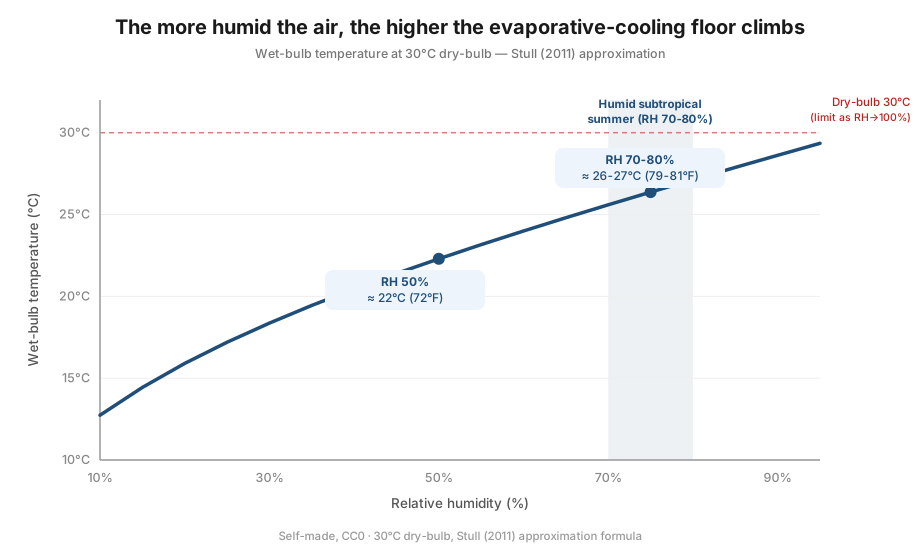
Wet-bulb temperature isn’t a fixed number; it depends on both the air’s actual (dry-bulb) temperature and its relative humidity. Solving for it exactly requires iterative psychrometric calculations, but meteorologist Roland Stull published a closed-form approximation in 2011, in the Journal of Applied Meteorology and Climatology, that gets within about ±1°C of the true value using only dry-bulb temperature and relative humidity as inputs.[2]
Here is dry-bulb temperature (°C) and is relative humidity (%). Plug in a plausible non-air-conditioned indoor summer temperature — 30°C (86°F) — and the wet-bulb temperature comes out to roughly 22°C (72°F) at 50% relative humidity.[2] Push the relative humidity up to 70%, though, and it climbs to about 25.6°C (78°F); at 75% it’s about 26.4°C (80°F); at 80% it reaches roughly 27.1°C (81°F).[2]
That range isn’t hypothetical for a lot of the world’s population. It’s what a non-air-conditioned room feels like across the U.S. Gulf Coast in August, through much of maritime Southeast Asia, and in Japan’s and Korea’s muggy monsoon summers — humid climates where indoor air, absent air conditioning, tends to track outdoor humidity closely. Korea’s own weather agency has hard numbers for one such case: the 1991–2020 climate normal puts Seoul’s average summer (June–August) relative humidity at 71.8%, and July alone sees stations across the greater Seoul area running between 76% and 84%.[3] Feed those figures back into Stull’s formula and the wet-bulb floor in a non-air-conditioned Korean summer room lands around 26–27°C (79–81°F) — barely below room temperature at all.[2][3]
The opposite case makes the point just as clearly. Arid climates can hit the same 30°C dry-bulb reading with far lower relative humidity, which drags the wet-bulb floor down substantially — which is exactly why evaporative “swamp coolers” remain a fixture of homes across the arid U.S. Southwest, where the gap between dry-bulb and wet-bulb temperature is wide enough for evaporation to do real work; the same equipment is far less effective in humid regions, for the same reason a wet bandana barely helps in Houston in August.[4] High humidity and “evaporative cooling barely helps” aren’t two separate complaints about summer — they’re the same physics.
When the target is below freezing, that floor is irrelevant from the start
Now shift the target to the ice cream. First it’s worth pinning down what “frozen” actually means as a physical temperature, not just a word. The European Union’s Quick-Frozen Foodstuffs Directive (89/108/EEC) defines a “quick-frozen” product as one whose core temperature is maintained at −18°C (0°F) or below, allowing only a brief, limited rise of up to 3°C during transport, local distribution, and retail display.[5] South Korea’s Ministry of Food and Drug Safety sets the same threshold in its own food standards, requiring frozen products to be stored and distributed at −18°C (0°F) or below.[6] These numbers are cited here purely to establish how cold “frozen” physically is — not to make any claim about shelf life or microbial safety, which this article deliberately sets aside.
The gap between the wet-bulb floor calculated above (roughly 22–27°C / 72–81°F) and that physical benchmark for “frozen” (−18°C / 0°F) is more than 40°C — a gap of over 70°F. Evaporative cooling can’t go below the wet-bulb temperature under any circumstances, so no amount of careful wetting or fan power closes a gap that size through evaporation alone. Cooling a frozen item down to where it needs to be simply isn’t a job evaporative cooling was ever built for. But the story doesn’t stop there — a wet cloth doesn’t just fail to close that gap. It actively speeds up how fast a frozen item thaws. That’s the part worth unpacking.
① Still air turns out to be an insulator
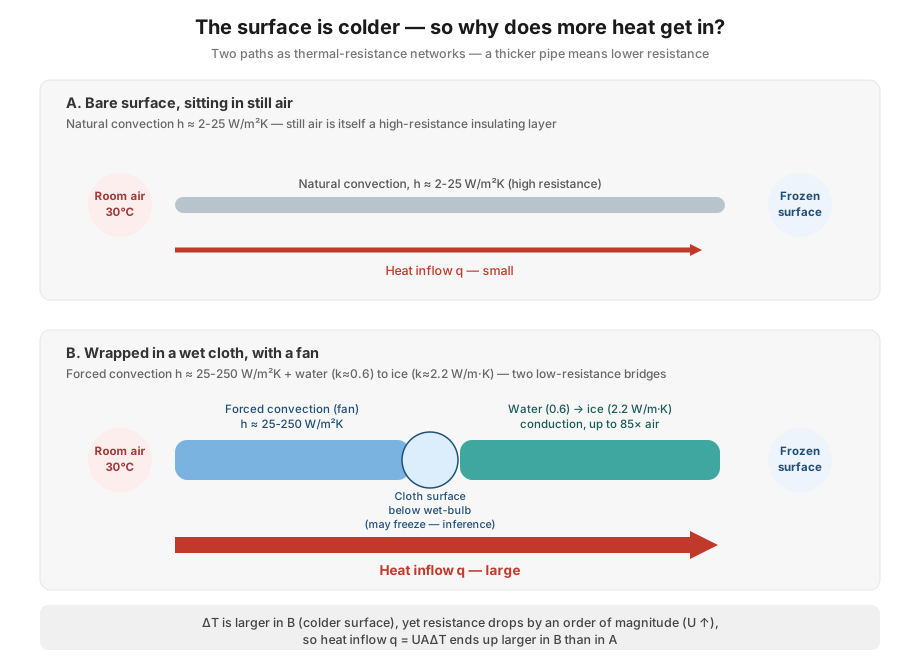
How fast heat moves between two objects depends not just on the temperature difference between them, but on how well whatever sits in between actually conducts it. Engineers quantify that with the convective heat transfer coefficient (, in ), and for natural convection in still air — no forced airflow — that coefficient runs only about for gases.[7] Air’s own thermal conductivity is only about at room temperature (25°C / 77°F) — roughly 1/23rd that of water, at about .[8][9] That’s why a pint of ice cream left bare on a countertop melts slower than a 30°C-to-freezer (86°F-to-freezer) temperature gap might suggest: the thin, still layer of air clinging to its surface is, functionally, insulation. The temperature difference between room and ice cream is large — but the channel heat has to travel through to get there is narrow, so the flow itself is slow.
② The wet cloth strips that insulation away
Now wrap that same container in a wet cloth. Still air gets replaced by a film of water across the surface. As just established, water conducts heat about 23 times better than air.[8][9] The thin, patchy air layer that had been acting as insulation gets swapped for a far better conductor. Already, at this point, the wet cloth reveals its actual character: it strips away an insulating layer of still air, rather than adding one.
③ It may even freeze into an ice bridge — from here on, this is inference
Worth flagging up front: everything in this section is inferred from heat-balance reasoning, not measured directly. The wet-bulb floor discussed earlier assumes the wet surface exchanges heat only with the surrounding air — the adiabatic saturation process.[1] A wet cloth wrapped around something frozen breaks that assumption. The cloth’s outer face still exchanges convective heat with room air and loses heat to evaporation, but its inner face is now in direct conductive contact with a second heat reservoir: the frozen item itself. Heat has exactly one way in (room air) and, now, two ways out (evaporation, plus conduction into the cold interior).
The first law of thermodynamics — conservation of energy — requires that, at steady state, heat in equals heat out.[10] The convective heat coming in from room air is fixed by ; with and both fixed, the only way for the outgoing heat (evaporation plus conduction, combined) to increase is for that temperature-difference term to grow. In other words, the cloth’s steady-state temperature has to drop further below room temperature than the plain wet-bulb value in order to balance the books — colder than pure evaporative cooling alone would predict. Push that temperature down far enough, past water’s freezing point (0°C / 32°F), and the cloth could freeze.
No direct measurement confirming how far this actually drops, or whether the cloth genuinely freezes in practice, turned up during this research. A handful of informal experiments running in the opposite direction — cooling a warm drink, rather than protecting something frozen — show up on personal blogs and forum posts, but their results are inconsistent and none meet a reliable sourcing bar, so none are cited here. The underlying principle (energy conservation) is solid; what doesn’t exist is a quantitative measurement of this exact scenario.
If the cloth does freeze, its material properties shift again. Ice’s thermal conductivity runs around near 0°C — more than triple water’s, and roughly 85 times air’s (most published values converge somewhere in a 2.1–2.6 W/(m·K) range, depending on the reference).[11] Still air (0.026) to water (0.6) to ice (2.2): each time the material wrapping the surface changes, thermal conductivity jumps by roughly an order of magnitude.
The nature of the phase change shifts too. While the cloth is still wet, capillary action (wicking) in the fibers keeps drawing water up to the surface to replace what evaporates, continuously pulling latent heat away. Once the surface freezes, evaporation (liquid to gas) gives way to sublimation (solid straight to gas), and capillary resupply stops entirely. Ice’s latent heat of sublimation — the latent heat of fusion (about 334 kJ/kg) plus the latent heat of vaporization near 0°C (about 2,501 kJ/kg), for a combined 2,834 kJ/kg — is actually larger than liquid water’s latent heat of vaporization alone.[12] But what matters isn’t the size of the latent heat; it’s how fast the phase change actually proceeds. At a given temperature, a solid’s saturation vapor pressure is lower than a liquid’s, so the mass loss rate through sublimation runs far slower than through liquid evaporation.[12] The moment the surface freezes, most of the cooling that evaporation had been providing effectively disappears, leaving only conduction through a highly conductive ice layer. This, too, is inference built from standard material properties — no direct measurement of this exact scenario exists.
④ A fan accelerates everything above
Add a fan, and the heat transfer coefficient jumps out of the natural-convection range into forced convection: .[7] That’s at least a 10-fold increase, and potentially closer to 100-fold. Wetting something down and pointing a fan at it is, mechanically, an act of converting still-air natural convection into forced convection — widening the channel that keeps ferrying 30°C (86°F) room air toward the surface, without pause. (The exact opposite extreme — a setting where convection can’t happen at all, because there’s no medium to carry it — is what makes heat loss in vacuum so slow; forced convection here sits at the other end of that same spectrum.)
⑤ The temperature gap widens; the heat flow doesn’t shrink
Pull all of this together into one equation. When heat crosses several layers in sequence, each layer’s resistance adds up in series:
Here is the convective heat transfer coefficient, is layer thickness, is that layer’s thermal conductivity, and is area. Without a wet cloth, natural convection (①, where is small) is the one bottleneck, and total resistance is high. Wrap the item in a wet cloth and add a fan, and convective resistance drops into the forced-convection range (④), while a low-resistance layer of water — or, worse, ice — gets stacked on top of that (②③). The overall heat transfer coefficient , resistance’s reciprocal, jumps by an order of magnitude or more, and heat inflow follows:
Here’s the counterintuitive part. Even as the cloth’s surface temperature drops below the wet-bulb temperature — even if it freezes, per the inference above — the temperature difference between room and surface actually grows. Intuition says a bigger temperature gap should mean better protection. But when the jump in outpaces the growth in , heat inflow can end up larger, not smaller.
Worth restating clearly one more time: no reliable direct measurement comparing “a wet-cloth-wrapped frozen item actually melts faster than a bare one” turned up in this research. The conclusion above is engineering inference assembled from standard heat transfer coefficients, material properties, and phase-change thermodynamics — not a measured head-to-head comparison. What is backed by standard material data is that both convective and conductive resistance drop, by an order of magnitude, at the same time — and the direction that points is unambiguous. Getting colder and conducting heat well are two different claims, and it’s easy to mix them up.
So how do you actually reach subzero?


If evaporative cooling can’t reach below freezing, getting there takes different physics entirely. The traditional method of hand-churning ice cream with ice and salt is exactly that. Pure water won’t drop below 0°C (32°F) no matter what you do to the air around it, but dissolving salt into it lowers its freezing point — a phenomenon called freezing point depression. In the sodium chloride (NaCl) and water binary system, pushing salt concentration up to 23.3% by weight reaches a eutectic point where the freezing point bottoms out at −21.1°C (−6°F).[13] Add more salt past that point and the temperature doesn’t drop any further — the eutectic point is the lowest freezing point that mixture can physically reach. “More salt, more cold” turns out to be true only up to that exact line.
Going lower than salt takes a different substance altogether. Dry ice — solid carbon dioxide — skips the liquid stage and turns straight to gas, and at one atmosphere it does so at roughly −78.5°C (−109°F).[14] That sits far below −18°C, which makes it the right tool for the job of keeping something frozen.
Step back and a rule comes into focus. Every coolant has a floor it cannot go below, and it only works as a coolant when that floor sits below your target.
| Method | Floor temperature | Holds −18°C (0°F)? |
|---|---|---|
| Evaporative cooling | Wet-bulb (≈22–27°C / 72–81°F indoors in summer) | No |
| Ice water | 0°C / 32°F | No |
| Ice + salt | −21.1°C / −6°F | Yes |
| Dry ice | ≈ −78.5°C / −109°F | Yes |
That table recasts a familiar scene: a cooler packed with ice. For a drink, 0°C is about as good as it gets — the target sits above the floor, so ice is an excellent coolant. For something that has to stay at −18°C, though, 0°C is 18 degrees too warm. Ice cream is doubly disadvantaged here, since the sugar dissolved in it depresses its freezing point below that of pure water, putting 0°C well inside the range where it has already started to soften.[15] In that situation ice isn’t a coolant at all — it’s a heat source. And exactly as the wet cloth did, the meltwater around it doubles as a bridge that carries heat some 23 times better than air.
With nothing else at all, the last resort is insulation, not cooling
For the same reason, if a frozen item is all you’re carrying, a closed cooler with nothing in it beats a cooler packed with ice. Inside an empty box nothing is forcing the interior to 0°C, so the coldest object in there is the frozen item itself, and heat can only arrive by leaking slowly through the insulated wall and then crossing a layer of still air with a low heat-transfer coefficient — two resistances stacked in series. Fill the box with ice and both of those resistances get bypassed: a 0°C heat source is now pressed directly against the frozen item. This holds only if the box itself starts out cold, though. A cooler that has been baking in the sun will hand over the heat stored in its walls and interior air. Like the comparison above, this follows from the thermal-resistance model rather than from any measurement.
With no fridge, no ice, and no salt, exactly one option is left: wrapping the item in newspaper or foam. That method doesn’t make anything colder — it slows down how fast it warms up. It runs on the same low thermal conductivity of still air (about 0.026 W/(m·K)) covered earlier.[9] Loose, porous materials like newspaper or foam work as insulation by trapping tiny pockets of still air that can’t circulate, suppressing convection and putting that low conductivity to use directly. Cooling and insulation are different physics — this is the same lesson, showing up one more time.
FACT
Evaporative cooling bottoms out at the wet-bulb temperature, and in a non-air-conditioned room during a humid subtropical or monsoon summer — relative humidity in the 70–80% range, whether that’s the U.S. Gulf Coast, coastal Japan, or Seoul — that floor climbs to roughly 26–27°C (79–81°F).[2][3] If the target is a lukewarm drink sitting above that number, a wet cloth is about as good a tool as you’ll find without a fridge. If the target is “frozen,” which physically means −18°C (0°F) or below, it was never within reach to begin with.[5][6] Worse, the wet cloth strips away the insulating layer of still air and replaces it with water — or even ice — both of which conduct heat far better. Getting colder and conducting heat well are separate facts, and it’s the second one, not the first, that melts the ice cream faster. Salt tops out at −21.1°C (−6°F) no matter how much you add, and when nothing else is on hand, the last resort left on the table is insulation, not cooling — for the same underlying reason.
References
[1]: ASHRAE, ASHRAE Handbook — Fundamentals, “Psychrometrics” chapter — the standard definition of wet-bulb temperature as an approximation of the adiabatic saturation process, and as the theoretical floor evaporative cooling can reach
[2]: Stull, R. (2011), “Wet-Bulb Temperature from Relative Humidity and Air Temperature,” Journal of Applied Meteorology and Climatology, 50(11), 2267–2269 — approximation formula (accurate to about ±1°C, valid for RH 5–99% and temperature −20 to 50°C). The figures in the text (dry-bulb 30°C: RH 50% → ≈22.3°C, RH 70% → ≈25.6°C, RH 75% → ≈26.4°C, RH 80% → ≈27.1°C) were calculated by direct substitution into this formula, https://doi.org/10.1175/JAMC-D-11-0143.1
[3]: Korea Meteorological Administration, Weather.go.kr, “Regional Climate Characteristics of Korea” (1991–2020 climate normals) — Seoul summer (June–August) average relative humidity of 71.8%; July relative humidity across greater-Seoul stations distributed between 76% and 84%, https://www.weather.go.kr/w/climate/statistics/region.do
[4]: U.S. Department of Energy, Energy Saver, “Evaporative Coolers” — evaporative (“swamp”) coolers rely on the same wet-bulb principle and are effective primarily in hot, dry climates, where the gap between dry-bulb and wet-bulb temperature is largest, https://www.energy.gov/energysaver/evaporative-coolers
[5]: Council Directive 89/108/EEC of 21 December 1988 on the approximation of the laws of the Member States relating to quick-frozen foodstuffs for human consumption, Annex — defines maintenance of product core temperature at −18°C or below, with a temporary deviation of up to +3°C permitted only during transport, local distribution, and retail display, https://eur-lex.europa.eu/eli/dir/1989/108/oj/eng
[6]: South Korea Ministry of Food and Drug Safety, “Standards and Specifications for Foods” (issued under Article 7 of the Food Sanitation Act) — frozen food storage and distribution standard of −18°C or below, https://www.mfds.go.kr/wpge/m_510/de050301l002.do
[7]: Bergman, T. L., Lavine, A. S., Incropera, F. P., DeWitt, D. P., Fundamentals of Heat and Mass Transfer, Table 1.1, “Typical Values of the Convection Heat Transfer Coefficient” — natural convection (gases) ; forced convection (gases)
[8]: CRC Handbook of Chemistry and Physics, “Thermal Conductivity of Liquids” — water’s thermal conductivity of approximately (at 25°C)
[9]: CRC Handbook of Chemistry and Physics, “Thermal Conductivity of Gases” — air’s thermal conductivity of approximately (at 25°C)
[10]: The steady-state energy balance required by the first law of thermodynamics (conservation of energy) — Çengel, Y. A., Ghajar, A. J., Heat and Mass Transfer: Fundamentals and Applications; the standard steady-state control-surface energy balance applied directly here to the wet-cloth/frozen-item system
[11]: CRC Handbook of Chemistry and Physics, “Thermal Conductivity of Ice” — ice’s thermal conductivity of approximately (near 0°C; most published sources converge on a 2.1–2.6 W/(m·K) range)
[12]: Water’s latent heat of fusion (~334 kJ/kg), latent heat of vaporization near 0°C (~2,501 kJ/kg), and ice’s latent heat of sublimation (~2,834 kJ/kg) — CRC Handbook of Chemistry and Physics and standard thermodynamics textbook phase-change latent heat tables; that saturation vapor pressure is higher for a liquid than a solid at the same temperature (above the triple point) is standard phase-equilibrium theory
[13]: NaCl–H₂O binary system eutectic point of −21.1°C (23.3 wt%) — a figure consistent across multiple standard phase-diagram references; the same principle used in road de-icing and traditional salt-and-ice ice cream freezing, https://www.fhwa.dot.gov/publications/research/safety/95202/005.cfm
[14]: Sublimation temperature of dry ice (solid carbon dioxide) at 1 atm, roughly −78.5°C. The figure is conditional: the widely quoted −78.5°C applies to dry ice sitting in an atmosphere saturated with its own vapor. Purandare, Verbruggen & Vanapalli (2023), “Experimental and theoretical investigation of the dry ice sublimation temperature for varying far-field pressure and CO2 concentration,” International Communications in Heat and Mass Transfer, measured −97.3°C in an unsaturated atmosphere at 1 atm and 0%vol CO2 — about 19°C below the commonly cited value. Either figure sits far below −18°C, so the argument here is unaffected, https://www.sciencedirect.com/science/article/pii/S0735193323004311
[15]: An ice cream mix freezes below the freezing point of water because dissolved sugars depress it, the same freezing-point-depression physics described above for salt. The standard reference in the field is H. D. Goff & R. W. Hartel, Ice Cream, 7th ed. (Springer, 2013), whose freezing-point-depression equation is routinely cited in subsequent modeling of the ice cream freezing process. No freezing point for any specific product is claimed here — only the qualitative point that 0°C already sits above that depressed range