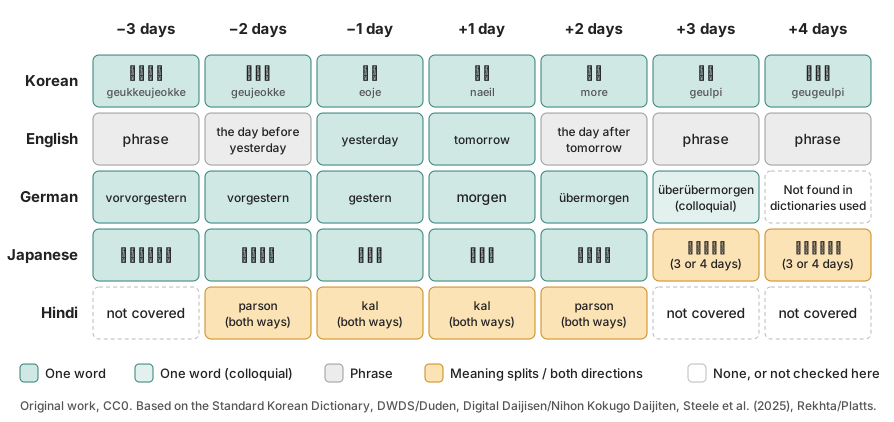
Quick: what do you call the day before yesterday? And the day after tomorrow? If you speak English, the honest answer is “the day before yesterday” and “the day after tomorrow”, four words each, and nobody has ever found this strange. A German speaker says vorgestern and übermorgen. A Japanese speaker says ototoi and asatte. A Korean speaker has a word for three days ago (geukkeujeokke) and another for four days from now (geugeulpi). So which of these languages is the odd one out? The usual guess is that Korean, with its long ladder of day names, is the showpiece. The dictionaries suggest the picture is more complicated, and the language that looks unusual may be the one you are reading this in.
Question
There are really two assumptions hiding in the idea that “other languages just stop at yesterday and tomorrow.” The first is that a language with a dedicated word for every day out to three or four days away is an exotic exception, with Korean as the extreme case. The second is that such a crowd of words must be confusing, so even native speakers trip over them. Both sound plausible, and few people check them against other languages.
This article checks how far out from today each language has a single-word name, using dictionaries. It also asks whether “a word exists” and “everyone means the same day by it” are really the same thing. Comparative surveys of this kind are rare, and none covers every language in the world. The five languages checked directly in dictionaries are English, German, Japanese, Korean and Hindi. Beyond those, only the range reported by comparative studies is added.
Check
1. English: the day after tomorrow, in four words
English has one word each for yesterday and tomorrow, and then switches to phrases: “the day before yesterday,” “the day after tomorrow.” Steele and colleagues (2025), who compared how English- and German-speaking children learn time words, put it plainly: German has vorgestern and übermorgen, but “English has no such words,” so speakers must use a whole phrase to refer to the time.[1]
Older English did have single words for ±2 days. The same paper calls ereyesterday and overmorrow “now-defunct,”[1] and the typology paper by Hölzl (2025) likewise introduces overmorrow as an “older English” counterpart of German über-.[2] Dictionaries disagree on how dead it is. The GCIDE (a Webster-derived dictionary) marks overmorrow as obsolete,[3] while Dictionary.com lists it as a noun and adverb meaning “the day after tomorrow,” records it from the 1530s, and carries no obsolescence label.[4] With labels that inconsistent, the fairest summary is “an old word no longer used in everyday speech.”
Why does English look like it stops at “yesterday and tomorrow”? Partly because phrases are not counted. Hölzl argues that “the day after tomorrow” is also a day name anchored on today and should count, and he criticizes earlier classifications that left it out.[2] Count phrases and English has ±2 as well. The difference is that it is a phrase, not a word.
2. German: three days back, three days ahead
The German dictionary DWDS glosses vorvorgestern as “vor drei Tagen” (three days ago), and Duden gives the same gloss. Neither dictionary attaches a colloquial label to that sense. The colloquial (umgangssprachlich) label in DWDS sits on an idiom, “von vorvorgestern sein,” meaning “to be hopelessly behind the times.”[5][6] Überübermorgen is different: DWDS glosses it as “am Tage nach übermorgen” (the day after the day after tomorrow), marks it umgangssprachlich, and gives the example “er kommt nicht übermorgen, sondern überübermorgen” (he’s not coming the day after tomorrow, but the day after that).[7] The standard word übermorgen is in Duden as “in zwei Tagen; an dem auf den morgigen Tag folgenden Tag” (in two days; the day following tomorrow).[8]
So German has names from −3 to +3 days. That is one day shorter than Korean on the future side, and neither Duden nor DWDS lists a word for +4. A dictionary entry is not the same as use, though. Hölzl cites raw frequencies from the Wortschatz Leipzig German corpus: gestern 34,508, vorgestern 1,044, vorvorgestern 9, übermorgen 621, überübermorgen 3. The words thin out fast toward the edges, and Hölzl notes that this kind of stacking in practice stops after a step or two.[2] The first assumption, that many day names are a Korean peculiarity, is already in trouble.
3. Japanese: the same range, but +3 and +4 come apart
Japanese dictionaries also have words from −3 to +4 days. The Digital Daijisen glosses sakiototoi (一昨昨日) as “the day before ototoi,”[9] and the Seisen-ban Nihon Kokugo Daijiten glosses asatte (明後日) as “the day after tomorrow.”[10] The trouble starts beyond that.
Shiasatte (明明後日) is glossed in the Digital Daijisen as “the day after asatte” and “the fourth day counting forward from today.” The Nihon Kokugo Daijiten says “the fourth day counting forward with today as day one,” which makes it three days from today. The Daijisen also adds a note that “some regions use it for the day after the day after asatte,” which is four days out.[11] The Nihon Kokugo Daijiten’s supplementary note goes further. For the day after asatte, eastern Japan says yanoasatte and western Japan says shiasatte, a clear east-west split, with the 23 wards of Tokyo as an exception that uses shiasatte. And yanoasatte itself has two senses in the same dictionary: “the day after tomorrow’s next day” (three days out) and “the fourth day counting tomorrow as day one” (four days out).[11][12]
The same split shows up in the question design of the Linguistic Atlas of Japan (日本言語地図), published by the National Institute for Japanese Language in 1966–74. Map 285 is “shiasatte,” with the English title “two days after tomorrow,” and Map 286 is “yanoasatte,” “three days after tomorrow.” The prompt on Map 286 asks, “What do you call the day after shiasatte?” and its legend lists more than a hundred form symbols, including yanoasatte, goasatte and yanoyanoasatte.[13] In other words, the atlas asks separately for the name of the third day and for the name of the day after that, and the answers varied widely by region. The survey predates the atlas’s publication, so today’s regional distribution may well differ.
You will often read that the shi in shiasatte comes from the word for “four.” No reliable source for that explanation could be found.
4. Korean: from −3 to +4 days
Now the language that started the question. In the Standard Korean Language Dictionary (표준국어대사전, compiled by the National Institute of Korean Language), geukkeujeokke (그끄저께) is “the day before geujeokke; the day three days before today.”[14] Geujeokke (그저께) is “the day before eoje (yesterday),” with geuje as a synonym.[15] More (모레) is “the day after tomorrow,”[16] geulpi (글피) is “the day after more,”[17] and geugeulpi (그글피) is “the day after geulpi; the day four days from today.”[18]
That makes yesterday, geujeokke and geukkeujeokke in the past (three days), and tomorrow, more, geulpi and geugeulpi in the future (four days). The ladder is not symmetric: the future is one day longer. This is the standard-language range.
What about the idea that Koreans themselves get confused? No error-rate statistics turned up. There are, however, queries to the National Institute of Korean Language, the state body that maintains the standard language. In 2020 someone asked whether geukkeuje and geugeulpi are usable words at all, and the Institute replied that both are standard.[19] In March 2026 another person asked whether it is fine to say geulpi, since it seems out of fashion and “in three days” or saheul (“three days”) might be better. The Institute answered that geulpi, “in three days” and saheul later mean the same thing, and that for someone who may not know geulpi, such as a child, “in three days” or “three days later” is better.[20]
So it is confirmed that these are standard words unfamiliar enough that speakers ask whether they may use them. How many speakers actually get them wrong cannot be told from this material.
5. Hindi: yesterday and tomorrow are one word
Hindi widens its range in the opposite direction. As Steele and colleagues describe it, Hindi has a single word, kal, for the day one step away from today, and the tense of the sentence decides whether it is yesterday or tomorrow.[1] Dictionaries say the same. The Rekhta dictionary lists “tomorrow, yesterday” in its English gloss for kal,[21] and Platts’s dictionary of Urdu, Classical Hindi and English (1884) defines kal as “Tomorrow, or yesterday,” adding that in the Deccan dialect it means only “yesterday.”[22]
One day further out is parson. Rekhta gives “day after tomorrow, day before yesterday,”[23] and Platts has “The second day before or after the present; the day before yesterday; the day after to-morrow.”[24] Beyond that (narson and others), dictionaries disagree on how many days they mean, so they have no single agreed sense.
By word count Hindi has far fewer than Korean. But because one word serves both directions, you could say Hindi covers ±2 days with single words. And Hindi is not alone in this. Hölzl gives the example of Nganasan (a Uralic language), which uses the same expression for yesterday and tomorrow, and for the day before yesterday and the day after tomorrow, with tense telling them apart.[2]
6. When there is no word
Languages with no word for a given day tend to use one of three workarounds.
First, take a day that already has a name and build a phrase on it. English “the day after tomorrow” does this,[1] and so does Udihe (a Tungusic language described by Hölzl), which says “after tomorrow” (tima:na ca:-la-ni) for the day after tomorrow.[2]
Second, state the distance as a number. English “three days ago” and “in three days” work this way. Hölzl reports that Italian says tre giorni fa for −3 and fra tre giorni for +3, and Thai says sǎam wan kɔ̀ɔn (“three days before”). Oromo (a Cushitic language) forms −3 to −5 days as “three days before,” “four days before,” “five days before,” combining a numeral with “day” and “before.”[2] The “three days later” that the National Institute of Korean Language recommends for someone who doesn’t know geulpi is the same strategy.[20]
Third, stack or add to the same frame. German adds prefixes repeatedly, as in vor-vor-gestern and über-über-morgen, and Standard Chinese adds 大 (“big”) to 后天 (day after tomorrow) and 前天 (day before yesterday) to make 大后天 (+3) and 大前天 (−3).[2]
Languages mix these methods rather than picking one. English uses phrases for ±2 and numbered expressions for ±3.

7. Weeks, months and years
The “next after next” step exists beyond days. In Korean, the week before last is jijinanju (지지난주, synonym jeonjeonju),[25] the year before last is jaejaknyeon (재작년; synonyms include geureokke and jijinanhae),[26] and the year after next is naehunyeon (내후년; synonyms myeonghunyeon and huhunyeon).[27] Dadaeum (다다음) is a contraction of daeumdaeum, “next-next.”[28]
Japanese does it with one prefix. The Digital Daijisen says 再来 (sai) attaches to a word for week, month or year to mean “the next after next,” and that for days 明後 (myōgo) is used instead. Examples are 再来週, 再来月 and 再来年.[29] 先先週 is “the week one before last week.”[30] The German Duden defines übernächste as “dem nächsten, der nächsten folgend” (following the next one), with übernächstes Jahr (the year after next) as an example.[31] English, as with days, leans on phrases. British English has fortnight as a single word for 14 days, though Dictionary.com notes it is rarely used in the US, where people usually say “two weeks.”[32] On the other side, yesterweek is in the dictionary but is rare enough that the entry comments that “unlike yesterday,” it is rarely used.[33]
| Step | English | German | Japanese | Korean |
|---|---|---|---|---|
| Day after tomorrow | the day after tomorrow | übermorgen | あさって (asatte) | more (모레) |
| The week after next | the week after next | übernächste Woche | 再来週 (saraishū) | dadaeum ju (다다음 주) |
| The month after next | the month after next | übernächster Monat | 再来月 (saraigetsu) | dadaeum dal (다다음 달) |
| The year after next | the year after next | übernächstes Jahr | 再来年 (sarainen) | naehunyeon (내후년) |
For Korean (dadaeum, naehunyeon), Japanese (再来-) and German (übernächst-), every entry in the table is a dictionary headword; English has no single word here, so the table gives the everyday phrase. What stands out is that for weeks, months and years, Japanese and German extend by a regular prefix (再来-, über-), whereas Korean mixes repeating the same syllable (jiji-, dada-) with Sino-Korean words such as jaejaknyeon and naehunyeon.
8. Why languages differ
The question “why does one language have words out to −3 days while another stops at yesterday?” has rarely been answered head-on. Hölzl points out that day names appear in almost every grammar of an individual language, yet surprisingly few typological studies compare them as a single semantic domain.[2] Scattered clues still point to four tendencies.
First, the farther a day is from today, the more likely it is to be a combination rather than a word. In the 157-language sample of Tent (1998), as reported by Hölzl, the number of day names per language ranges from 3 to 13, and systems that stop at ±2 days are the most common, with larger ones much rarer. In the same sample, 116 languages have a single-morpheme expression for −1 day and 126 for +1, but only 6 for −3, the rest being compounds to some degree.[2] Korean’s −3 to +4 sits at the wide end of that distribution. Hölzl himself criticizes Tent’s classification as inconsistent, for example for not counting English phrases, so these figures are best read as a trend.[2]
Second, frequent words get short. As the German frequencies above show, words for nearby days are used often and become short, unanalyzable words, while words for far days are rare and stay as combinations. Hölzl connects this to Zipf’s law of abbreviation, the principle that frequently used words get shorter.[2]
Third, contact can reshape a system. Hölzl describes the Manchuric languages as having an “unusual asymmetric system” that sets them apart from other Tungusic languages, and explains the difference by language contact.[2] Even within one family, day-name systems are not fixed to one mold.
Fourth, dense word sets may make the distinctions easier for children to learn. Steele and colleagues compared 304 English- and German-speaking children aged 3 to 7 and found that the German children understood the exact distance meanings of time words better. The authors suggest this may be because German places more words close to today.[1] That is a finding about the effect of having the words, not about why they arose, and the authors do not claim causation.
In short, languages chose differently between vocabulary, prefix stacking, and phrasing, while the tendency for nearby days to harden into words is common to many. When and how each language made its choice lies outside the literature checked here.
Fact
Korean names every day from −3 (geukkeujeokke) to +4 (geugeulpi) with a single word, which is wide, but not unique. German has words from −3 to +3 (vorvorgestern through überübermorgen), and Japanese has dictionary words from −3 to +4 (sakiototoi through yanoasatte). In Tent’s 157-language sample, the most common system, as Hölzl reports it, reaches only ±2 days, so a language that reaches ±3 or beyond with single words is actually the unusual one.[2] English stops at yesterday and tomorrow and uses phrases beyond that, and Hindi takes another route, one word that covers both yesterday and tomorrow.
And a bigger vocabulary does not buy agreement on meaning. Japanese shiasatte has two dictionary glosses, three days out and four, side by side. The Korean dictionary says geugeulpi is “four days from today,” yet the institute that maintains it tells people to say “in three days” when the listener might not know the word. A word in the dictionary and a word that gets understood are two different things.
So the accurate answer to “Is Korean the only one this detailed?” is no. Next to English, Korean looks lavish, but beside German and Japanese it is simply a neighbor. If any language in this lineup is the outlier, it is English, which has a perfectly good word, overmorrow, that Dictionary.com still lists, though nobody has used it at the dinner table in a long time.[4]
References
[1]: Steele et al., “Today, Tomorrow, and Overmorrow: The Acquisition of Deictic Temporal Terms in English and German,” Open Mind 9 (2025), pp. 1826–1848, DOI 10.1162/OPMI.a.254. English needs phrases; ereyesterday and overmorrow are “now-defunct”; Hindi kal distinguishes direction by tense; comparison of children aged 3 to 7 (N=304). https://pmc.ncbi.nlm.nih.gov/articles/PMC12594576/
[2]: Hölzl, Andreas, “A Typology of the Deictic Day Name System in Manchuric,” in Time in East Asian Endangered Languages (Eurasiatica 22), Edizioni Ca’ Foscari, 2025, pp. 189–218, DOI 10.30687/978-88-6969-913-9/008 (CC BY 4.0). Sec. 1 status of English phrases and Nganasan polysemy; sec. 2.1 Tent (1998) sample and Table 5 (Tent is cited through Hölzl, not read directly); sec. 2.3 German frequencies (Table 7); sec. 2.5 lexical symmetry; sec. 2.6 auxiliary reference points; Tables 1 and 4 (Chinese, Italian, Thai); sec. 4.3 language contact. https://edizionicafoscari.it/media/pdf/books/978-88-6969-913-9/978-88-6969-913-9-ch-08.pdf
[3]: Wordnik, “overmorrow.” GNU version of the Collaborative International Dictionary of English (Webster-derived): “The day after or following to-morrow.” Noun, marked obsolete. https://www.wordnik.com/words/overmorrow
[4]: Dictionary.com, “overmorrow.” “The day after tomorrow,” noun and adverb, first recorded in the 1530s, no obsolescence label. https://www.dictionary.com/browse/overmorrow
[5]: DWDS (Digitales Wörterbuch der deutschen Sprache), “vorvorgestern.” Gloss “vor drei Tagen” with no usage label; the umgangssprachlich label appears only on the idiom “von vorvorgestern sein.” https://www.dwds.de/wb/vorvorgestern
[6]: Duden, “vorvorgestern.” “vor drei Tagen,” no usage label. https://www.duden.de/rechtschreibung/vorvorgestern
[7]: DWDS, “überübermorgen.” Gloss “am Tage nach übermorgen,” usage label umgangssprachlich (eWDG 1976), example “er kommt nicht übermorgen, sondern überübermorgen.” https://www.dwds.de/wb/überübermorgen
[8]: Duden, “übermorgen.” “in zwei Tagen; an dem auf den morgigen Tag folgenden Tag.” https://www.duden.de/rechtschreibung/uebermorgen
[9]: デジタル大辞泉 (Digital Daijisen), 「一昨昨日」: “おとといの前の日。さきおとつい。” (via Kotobank) https://kotobank.jp/word/一昨昨日-434135
[10]: 精選版 日本国語大辞典 (Seisen-ban Nihon Kokugo Daijiten), 「あさって【明後日】」: “あすの次の日。みょうごにち。” (via Kotobank) https://kotobank.jp/word/明後日-424128
[11]: デジタル大辞泉 and 精選版 日本国語大辞典, 「し‐あさって(明明後日)」. Daijisen: “今日から数えて未来へ4日目。明後日の翌日。「あさって」の翌々日をいう地方もある。” Nihon Kokugo Daijiten: “あさっての次の日。今日を一日目として未来へ四日目。” Supplementary note: “「あさっての翌日」は、東日本がヤノアサッテ、西日本がシアサッテという東西対立分布がある。しかし、東京都区内は例外的にシアサッテである。” (via Kotobank) https://kotobank.jp/word/明明後日-515366
[12]: 精選版 日本国語大辞典, 「や‐の‐あさって【彌明後日】」: “明日の翌々日。あさっての次の日。” and “明日を第一日として四日目。あさっての次の次の日。” (via Kotobank) https://kotobank.jp/word/彌明後日-2089335
[13]: 国立国語研究所 (National Institute for Japanese Language), 『日本言語地図』 (Linguistic Atlas of Japan, 1966–74, 6 vols.), vol. 6, Map 285 「しあさって(明明後日)」 (two days after tomorrow) and Map 286 「やのあさって(明明明後日)」 (three days after tomorrow), question text and legend. https://mmsrv.ninjal.ac.jp/laj_map/ (plate PDF: https://mmsrv.ninjal.ac.jp/laj_map/data/laj_map/LAJ_286.pdf)
[14]: National Institute of Korean Language, Standard Korean Language Dictionary (표준국어대사전), “그끄저께” (geukkeujeokke): “그저께의 전날. 오늘로부터 사흘 전의 날을 이른다.” (the day before geujeokke; the day three days before today). Synonyms 삼작일, 재재작일. https://stdict.korean.go.kr/search/searchResult.do?pageSize=10&searchKeyword=그끄저께
[15]: Standard Korean Language Dictionary, “그저께” (geujeokke): “어제의 전날.” (the day before yesterday). Synonym 그제. https://stdict.korean.go.kr/search/searchResult.do?pageSize=10&searchKeyword=그저께
[16]: Standard Korean Language Dictionary, “모레” (more): “내일의 다음 날.” (the day after tomorrow). Synonyms 내일모레, 명후일, 재명일. https://stdict.korean.go.kr/search/searchResult.do?pageSize=10&searchKeyword=모레
[17]: Standard Korean Language Dictionary, “글피” (geulpi): “모레의 다음 날.” (the day after more). Synonym 삼명일. https://stdict.korean.go.kr/search/searchResult.do?pageSize=10&searchKeyword=글피
[18]: Standard Korean Language Dictionary, “그글피” (geugeulpi): “글피의 그다음 날. 오늘로부터 나흘 뒤의 날을 이른다.” (the day after geulpi; the day four days from today). https://stdict.korean.go.kr/search/searchResult.do?pageSize=10&searchKeyword=그글피
[19]: National Institute of Korean Language, Q&A (“묻고 답하기”), “‘그끄제’, '그글피’의 표현” (Jan. 16, 2020): “‘그끄제’, ‘그글피’ 모두 쓸 수 있는 말입니다. '그끄제’는 ‘그끄저께’('그저께’의 전날)의 준말이고, '그글피’는 '글피의 다음 날’을 이르는 명사로 표준어입니다.” (Both can be used; geukkeuje is a contraction of geukkeujeokke, and geugeulpi is a standard-language noun for the day after geulpi.) https://www.korean.go.kr/front/mcfaq/mcfaqView.do?mn_id=&mcfaq_seq=9270
[20]: National Institute of Korean Language, Online Ganada (“온라인 가나다”), “글피” (answered Mar. 23, 2026). Geulpi, “3일 후(뒤)” and “사흘 후(뒤)” mean the same, and for someone who may not know geulpi, “3일 후(뒤)” or “사흘 후(뒤)” is better. https://www.korean.go.kr/front/onlineQna/onlineQnaView.do?mn_id=216&qna_seq=328382
[21]: Rekhta Dictionary, “kal.” English gloss “rest, ease, tomorrow, yesterday.” https://rekhtadictionary.com/meaning-of-kal
[22]: Platts, John T., A Dictionary of Urdū, Classical Hindī, and English (London: W. H. Allen, 1884), p. 840, kal (کل, Hindi s.m. and adv. entry): “Tomorrow, or yesterday”; only “yesterday” in the Deccan dialect. Online edition (DSAL, University of Chicago): https://dsal.uchicago.edu/cgi-bin/app/platts_query.py?qs=کل&searchhws=yes&matchtype=exact
[23]: Rekhta Dictionary, “parson.” “day after tomorrow, day before yesterday.” https://rekhtadictionary.com/meaning-of-parson
[24]: Platts, A Dictionary of Urdū, Classical Hindī, and English (1884), p. 249, parsoṅ (پرسوں): “The second day before or after the present; the day before yesterday; the day after to-morrow.” https://dsal.uchicago.edu/cgi-bin/app/platts_query.py?qs=پرسوں&searchhws=yes&matchtype=default
[25]: Standard Korean Language Dictionary, “지지난주” (jijinanju): “지난주의 바로 앞의 주.” (the week just before last week). Synonym 전전주. https://stdict.korean.go.kr/search/searchResult.do?pageSize=10&searchKeyword=지지난주
[26]: Standard Korean Language Dictionary, “재작년” (jaejaknyeon): “지난해의 바로 앞의 해.” (the year just before last year). Synonyms 거거년, 그러께, 전전년, 전전해, 지지난해. https://stdict.korean.go.kr/search/searchResult.do?pageSize=10&searchKeyword=재작년
[27]: Standard Korean Language Dictionary, “내후년” (naehunyeon): “내년의 다음다음 해.” (the year after next year). Synonyms 명후년, 후후년. https://stdict.korean.go.kr/search/searchResult.do?pageSize=10&searchKeyword=내후년
[28]: Standard Korean Language Dictionary, “다다음” (dadaeum): contraction of “다음다음.” https://stdict.korean.go.kr/search/searchResult.do?pageSize=10&searchKeyword=다다음
[29]: デジタル大辞泉, 「再来」: “週・年月などを表す語の上に付いて、次の次の、翌々という意を表す。” Note: “「日にち」には、「明後」を用いる。” (via Kotobank) https://kotobank.jp/word/再来-508606
[30]: 精選版 日本国語大辞典, 「先先週」: “先週のひとつ前の週。” (via Kotobank) https://kotobank.jp/word/先先週-310335
[31]: Duden, “übernächste.” “dem nächsten, der nächsten folgend,” example übernächstes Jahr. https://www.duden.de/rechtschreibung/uebernaechste
[32]: Dictionary.com, “fortnight.” British usage, “a period of 14 consecutive days; two weeks”; rarely used in the US, where “two weeks” is usual. https://www.dictionary.com/browse/fortnight
[33]: Dictionary.com, “yesterweek.” “Last week,” first recorded 1830–40, “Unlike yesterday, though, yesterweek is rarely used.” https://www.dictionary.com/browse/yesterweek