Walk past a window air conditioner or a condenser unit on a hot afternoon and you’ll feel it: not a cool breeze, but a blast of hot air. It’s a strange thing for a cooling machine to do. If an air conditioner’s whole job is to make a room cold, why does half of the machine spend its time doing the opposite — exhaling heat?
QUESTION
The easy assumption goes something like this: the outdoor unit pulls in outside air, chills it somehow, and pipes that now-cold air inside through the tubing that connects the two halves of the system. The hot air blowing out of the outdoor unit gets filed away as some kind of byproduct — exhaust, basically.
But look closely at the tubing running between the indoor and outdoor units and the theory falls apart. It isn’t a wide, insulated duct. It’s two thin copper lines, each barely wider than a finger. Could that possibly carry enough air to cool an entire room? And if the plan really were “cool outside air, then pump it inside,” why would you bother re-chilling summer air at all, rather than just, say, opening a window at night? Before going any further, it’s worth confirming what’s actually flowing through those two copper lines — because it isn’t air.
CHECK
What’s inside the tubing isn’t air — it’s refrigerant
When an air conditioner is installed, the two thin copper lines connecting the indoor and outdoor units are called the suction line and the liquid line. Neither carries air. Both carry a refrigerant — a chemical compound engineered to boil and condense at convenient temperatures and pressures. Low-pressure, cold refrigerant gas leaves the indoor evaporator coil and travels through the suction line to the compressor in the outdoor unit. Once compressed into a hot, high-pressure gas, it moves through the discharge line — a short run of tubing entirely inside the outdoor unit, connecting the compressor to the condenser — into the condenser coil. There it gives up heat and turns back into a liquid, which then returns to the indoor unit through the liquid line.[1]
That layout settles the question. Indoor air stays indoor: a fan inside the indoor unit pulls room air in, cools it, and blows it right back into the same room. Outdoor air stays outdoor: a fan inside the outdoor unit pulls in the air immediately around it, warms it, and releases it back outside. The only thing connecting the two units is refrigerant tubing, and only refrigerant flows through it — never air. The two air streams, indoor and outdoor, never mix. Outside air never enters the room, and room air never escapes outside, at least not through this basic refrigeration loop. (Ventilation systems built around an energy-recovery ventilator do bring in a small amount of fresh outdoor air through separate ductwork, but that’s a distinct add-on, not part of the refrigeration cycle itself.)
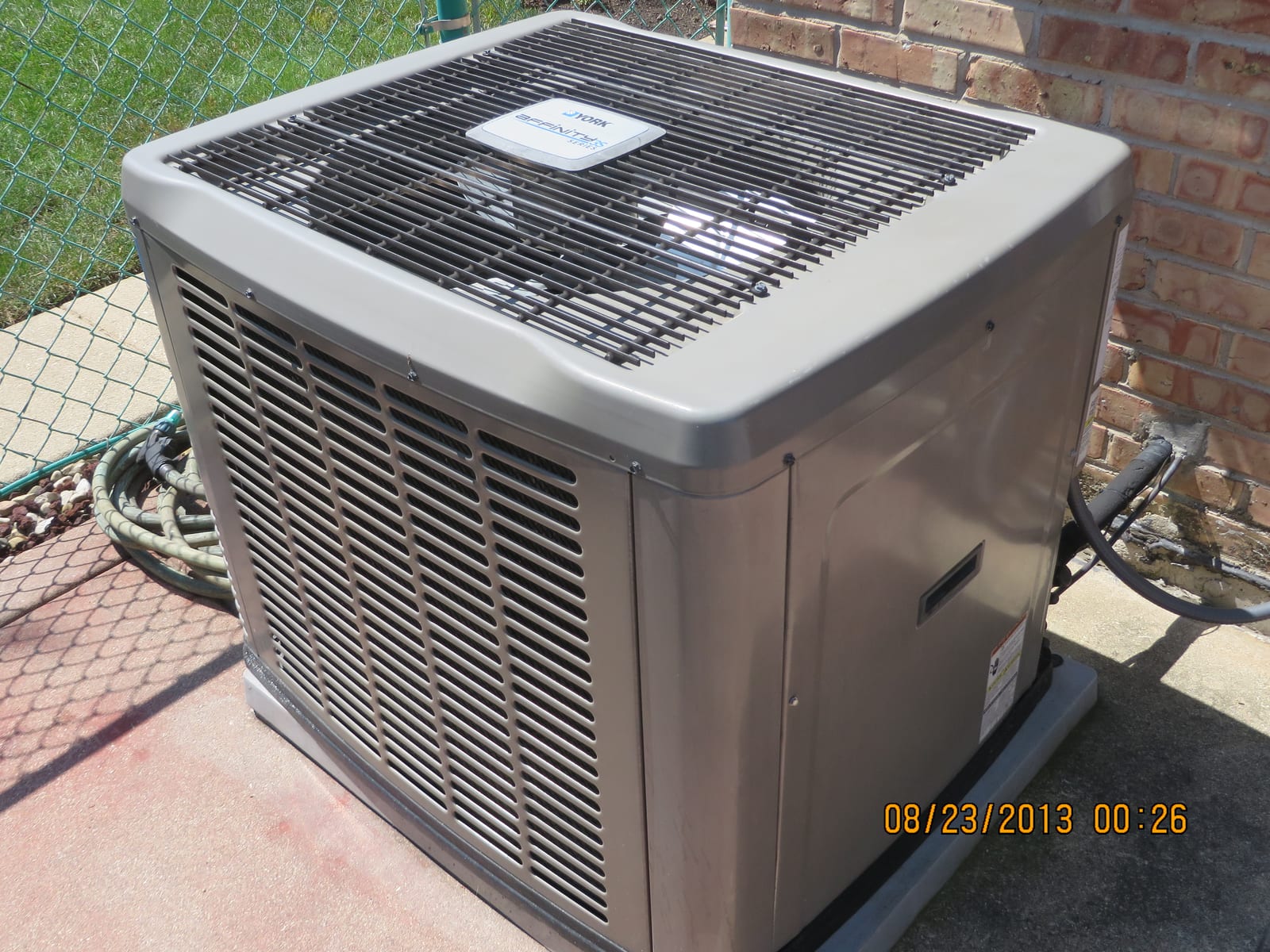
This misunderstanding causes real problems in the field. Treat the outdoor unit as “just a box that blows hot air” and it’s tempting to wedge it into a cramped balcony corner, a tight side yard, or anywhere airflow is an afterthought. But the outdoor unit’s actual job is to dump the heat pulled from indoors into the surrounding air — and if that airflow is blocked, the heat has nowhere to go, and system performance drops. Installation manuals from major manufacturers, including Daikin, specify minimum clearances from walls and obstructions around the intake and discharge airflow, plus height limits for any wall facing the discharge side, precisely to keep that path open.[2]

Heat doesn’t flow backward on its own
So how does heat from a warm room end up loaded onto refrigerant, and how does that refrigerant then dump its cargo into outdoor air that’s already hotter than the room was? The Clausius statement of the second law of thermodynamics answers that directly: “It is impossible to construct a device that operates in a cycle and produces no effect other than the transfer of heat from a cooler to a hotter body.”[3] Heat flows from hot to cold on its own. Moving it the other way always requires outside work.
An air conditioner supplies exactly that work through an electrically driven compressor — which is why an air conditioner is, technically, a heat pump. A heat pump doesn’t create heat; it forcibly relocates heat that already exists, hauling it from the cooler side (indoors) to the warmer side (outdoors). Cooling a room, in other words, isn’t about destroying the heat in it. It’s about moving that heat somewhere else and making someone else deal with it.
Four steps, one cycle: the vapor-compression refrigeration cycle
That relocation happens through the vapor-compression refrigeration cycle, in which refrigerant repeatedly shifts between liquid and gas. The cycle runs on four components: the compressor, the condenser, the expansion valve, and the evaporator.[4][11]
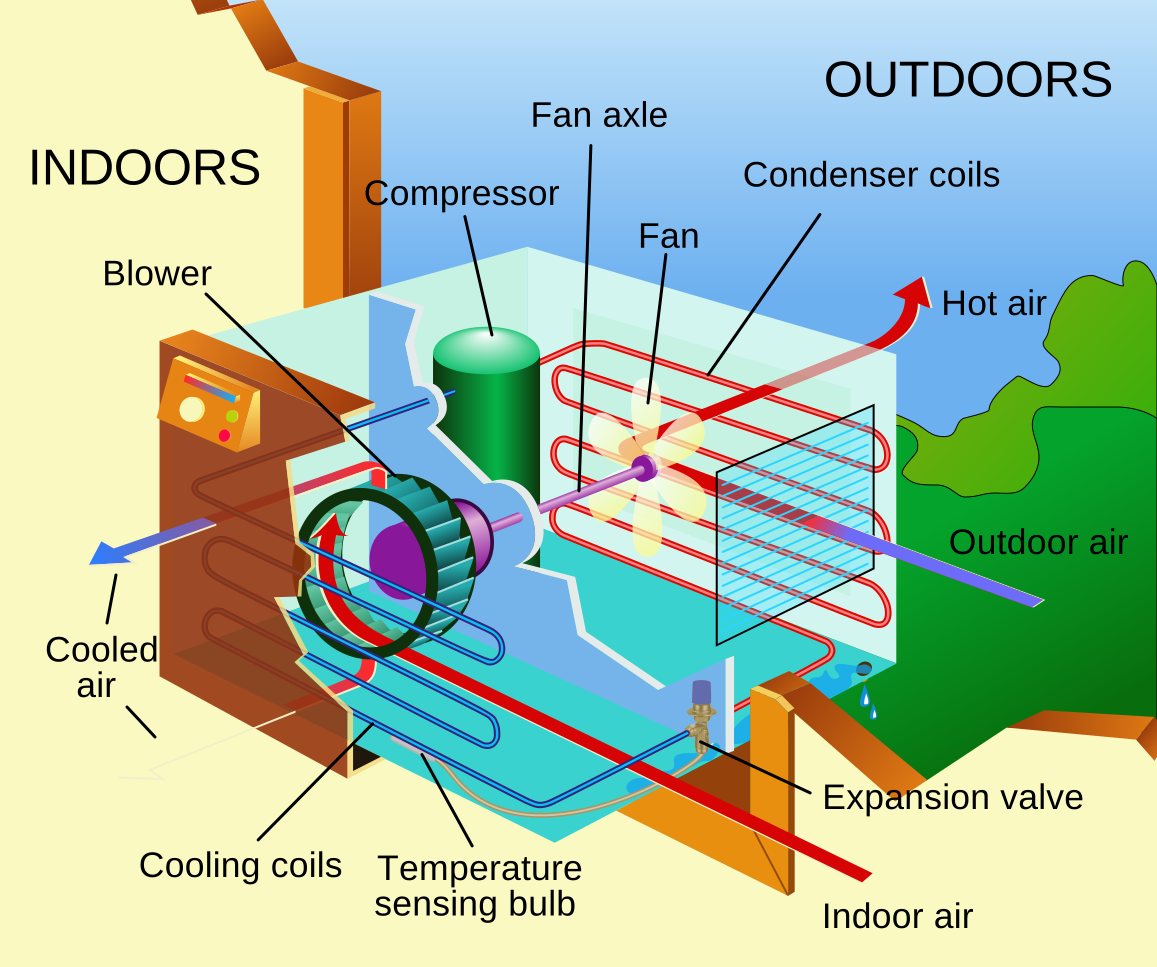

- Compression (outdoor unit): Low-pressure, low-temperature refrigerant gas leaving the evaporator gets squeezed hard by the compressor. Compressing a gas raises its temperature, so the refrigerant emerges as a hot, high-pressure gas.
- Condensation (outdoor unit): That hot, high-pressure gas travels through the fine tubing of the condenser coil and gives up heat to the outside air. As it loses heat, it cools and condenses into a liquid. This is the exact step where the outdoor unit’s fan blows out hot air.
- Expansion (at the connection between the two lines): The high-pressure liquid refrigerant passes through a narrow capillary tube or an expansion valve and its pressure drops sharply. Expanding a gas or liquid lowers its temperature, so the refrigerant comes out as a low-pressure, low-temperature liquid (partly mixed with gas).
- Evaporation (indoor unit): The now-cold refrigerant enters the indoor evaporator coil and meets room air. At low pressure it boils off into gas, and boiling requires energy — energy it pulls from the surrounding air as latent heat of vaporization (the heat absorbed or released during a change of state, without any change in temperature). Stripped of that heat, the room air cools and gets blown back into the room.[10]
After step four, the refrigerant is back to being a low-pressure gas headed into the compressor, and the cycle repeats. Throughout all four steps, the heat pulled from the room simply rides along on the refrigerant. Indoor air and outdoor air never touch.
One rule holds the whole cycle together: compress it and it heats up, expand it and it cools down
Every step above rests on a single physical rule: compress a gas adiabatically (without exchanging heat with its surroundings) and its temperature rises; let it expand the same way and its temperature falls. For an adiabatic process, the relationship between pressure and temperature is given by:[5]
Here is absolute temperature, is pressure, and is the gas’s specific heat ratio (the ratio of specific heat at constant pressure to specific heat at constant volume). When the pressure ratio is greater than 1 (compression), the temperature ratio is greater than 1 as well; when the pressure ratio is less than 1 (expansion), so is the temperature ratio. The compressor heating the refrigerant and the expansion valve cooling it down are the same equation, read from opposite ends.
You can feel this rule at work outside an HVAC system, too: a bicycle pump’s barrel warms up as you compress air into a tire, and a spray can gets noticeably colder the longer you hold the nozzle down.[12] The pump is compression; the spray can is expansion.
Different systems, different refrigerants
Not every system uses the same refrigerant. Household air conditioners commonly run on R-32 or R-410A, while automotive systems typically use R-134a or its successors — naming conventions set by international standards that classify refrigerants by chemical composition and safety.[6] Each refrigerant has its own boiling point and pressure behavior, so operating temperatures shift slightly from system to system, but in a typical residential cooling system the evaporator side tends to run around 0–10°C (32–50°F), while the condenser side runs hotter than the outdoor air, typically in the 40–60°C (104–140°F) range.[7] Those are representative ranges, not fixed values — the actual numbers depend on the refrigerant, the system’s design, and the outdoor temperature on a given day.
A refrigerator is, mechanically, the same machine
Put all of that together and the conclusion is unavoidable: a refrigerator runs the identical vapor-compression cycle, with the same compressor, condenser, expansion device, and evaporator.[7] The only real difference is what’s being cooled. A refrigerator cools the inside of a small, insulated cabinet and dumps the heat from its condenser (that grille or coil on the back or underneath) straight into the kitchen air. An air conditioner just cools a much bigger space — an entire room — and its condenser lives outdoors, so the waste heat goes into the backyard instead of the kitchen. The faint warmth radiating off the back of a refrigerator and the blast of hot air from an AC condenser unit come from exactly the same cause: the instant the compressor squeezes the refrigerant, heat is generated, and that heat exits through the condenser.
An even more violent case of compression heat: spacecraft re-entry
“Compress a gas and it heats up” shows up at a far more dramatic scale than any kitchen appliance. When a spacecraft re-enters the atmosphere and its surface heats to thousands of degrees, the common explanation is “friction with the air.” Friction does play some role, but it isn’t the main event.
In 1952, H. Julian Allen of NASA’s predecessor, NACA, at the Ames Research Center, was studying how objects heat up entering the atmosphere at supersonic speed and developed what became known as blunt-body theory.[8] When a spacecraft slams into the atmosphere at extreme speed, the air directly ahead of it doesn’t have time to get out of the way. It piles up into an extremely thin, dense bow shock just in front of the vehicle’s nose. Inside that shock layer, air gets compressed violently in an instant — and the same adiabatic pressure-temperature relationship described above kicks in, heating that compressed air to thousands of kelvin. Allen’s insight was that shaping a vehicle to be blunt, rather than needle-sharp, pushes that shock wave farther away from the surface, so most of that superheated air never actually touches the spacecraft — much of the heat gets carried away into the surrounding flow instead.[9] That principle became the standard for reentry capsule design, from Mercury and Apollo through today’s spacecraft.
In short, the dominant source of re-entry heating isn’t air molecules scraping against the spacecraft’s skin — it’s compression heat, generated the instant air that has nowhere else to go gets crushed by a vehicle moving at extreme speed. That doesn’t mean friction contributes nothing, but the dominant heat source is compression.[8] An air conditioner’s compressor squeezing refrigerant and a bow shock squeezing air ahead of a spacecraft operate at wildly different scales, speeds, and purposes — but they run on the exact same physics: compress a gas, and it gets hot.
FACT
An air conditioner doesn’t manufacture cold air — it’s a heat pump that keeps recycling the same room air while shuttling the heat inside it out to the refrigerant, and from the refrigerant to the outdoors. Only refrigerant flows through the tubing connecting the indoor and outdoor units; indoor and outdoor air never mix. That heat transfer runs on the exact same vapor-compression refrigeration cycle as a refrigerator, and the whole cycle rests on one line of physics: — compress it and it heats up, expand it and it cools down. The mild warmth off the back of a fridge, the blast of hot air from an AC condenser, and a spacecraft glowing at thousands of degrees during re-entry are the same physical law playing out at three wildly different scales. The hot exhaust your AC blows out as a thank-you for cooling your room turns out to be a very, very small cousin of the phenomenon that can burn up a spacecraft.
References
[1]: Carrier, “What is a Split HVAC System? Your Guide To Split AC Units” — overview of indoor/outdoor units connected via refrigerant copper tubing, https://www.carrier.com/us/en/residential/hvac-resources/air-conditioners/what-is-split-hvac-system/ ; American Standard, “What Are HVAC Refrigerant Lines?” — definitions and locations of the suction line, liquid line, and discharge line, https://www.americanstandardair.com/resources/glossary/refrigerant-lines/
[2]: Daikin, R32 Split Series outdoor unit installation manual — minimum clearance requirements from walls/obstructions to keep intake and discharge airflow unobstructed, plus discharge-side wall height limits, https://www.daikin.eu/content/dam/document-library/installation-manuals/ac/split/FTXJ-MW_FTXJ-MS_3PEN393185-6K_Installation manuals_English.pdf
[3]: OpenStax, University Physics Volume 2, §4.4 “Statements of the Second Law of Thermodynamics” (Clausius statement: “It is impossible to construct a device that operates in a cycle and produces no effect other than the transfer of heat from a cooler to a hotter body”), https://openstax.org/books/university-physics-volume-2/pages/4-4-statements-of-the-second-law-of-thermodynamics
[4]: M. Bahrami, Simon Fraser University, ENSC 388 lecture notes, “Vapor Compression Refrigeration Cycle” — the four-stage structure of compressor, condenser, expansion valve, and evaporator, https://www.sfu.ca/~mbahrami/ENSC 388/Lab/Experimrnt 2/Vapor Compression Refrigeration Cycle.pdf
[5]: University of Waterloo, ME354 lecture notes, Ch. 2 — the adiabatic (isentropic) pressure-temperature relationship , https://www.mhtlab.uwaterloo.ca/courses/me354/lectures/pdffiles/ch2.pdf
[6]: ANSI/ASHRAE Standard 34, “Designation and Safety Classification of Refrigerants” — the numbering system behind refrigerant designations such as R-32, R-410A, and R-134a
[7]: Y. A. Çengel, M. A. Boles, Thermodynamics: An Engineering Approach, “Refrigeration Cycles” chapter — the vapor-compression refrigeration cycle as the common principle underlying refrigerators, air conditioners, and heat pumps
[8]: NASA History Office, This New Ocean: A History of Project Mercury, SP-4201, Ch. 3-3, “Reentry: Aerodynamics to Thermodynamics” — H. Julian Allen’s blunt-body theory, https://www.hq.nasa.gov/pao/History/SP-4201/ch3-3.htm
[9]: NASA Ames Research Center History Archives, “H. Julian Allen” biographical materials — background on the 1952 development of blunt-body theory, https://history.arc.nasa.gov/hist_pdfs/bio_allen_pub.pdf
[10]: Latent heat of vaporization and phase-change heat transfer — Y. A. Çengel, M. A. Boles, Thermodynamics: An Engineering Approach, chapters on phase change and latent heat
[11]: MEP Academy, “How HVAC Split System Air Conditioners Work” — description of refrigerant state changes through the compression, condensation, expansion, and evaporation stages, https://mepacademy.com/how-hvac-split-system-air-conditioners-work/
[12]: Everyday examples of gas temperature change under adiabatic compression/expansion (bicycle pumps, aerosol cans) are consequences of the same adiabatic pressure-temperature relationship documented in [5]