Walk down the fan or vacuum aisle of any appliance store and you’ll see a sticker: “Brushless motor inside.” It’s usually attached to the pricier model — the same size unit for $20–$40 more. Ask a salesperson why, and the answer is almost always some version of “it’s a better motor, it doesn’t have brushes.” Push further and ask what a brush actually did, or why removing it makes anything better, and the explanation usually falls apart.
There’s a second oddity buried in the label. BLDC stands for “Brushless DC” — a direct-current motor. Yet that fan is plugged straight into a wall outlet that supplies alternating current (120V in the US, 230V in the UK and much of Europe). How does a “DC motor” run on an AC socket without so much as a second thought?

QUESTION
“No brushes, so it’s better” is half right and half hand-waving. To pin it down, you first need to know what a brush actually did. In a brushed DC motor, the brush and commutator exist to periodically flip the direction of current flowing through the rotor windings — a process called commutation. Without it, the motor wouldn’t turn; it would twitch once and stop.
So the real question narrows to three parts. Did BLDC actually eliminate commutation, or just relocate it? Why does a motor named for direct current run happily on an AC wall socket? And how much electricity does removing the brush actually save — is the price premium on that sticker backed by a real number, or is it mostly a halo of “premium” branding?
CHECK
Brushed DC: commutation solved by physical contact
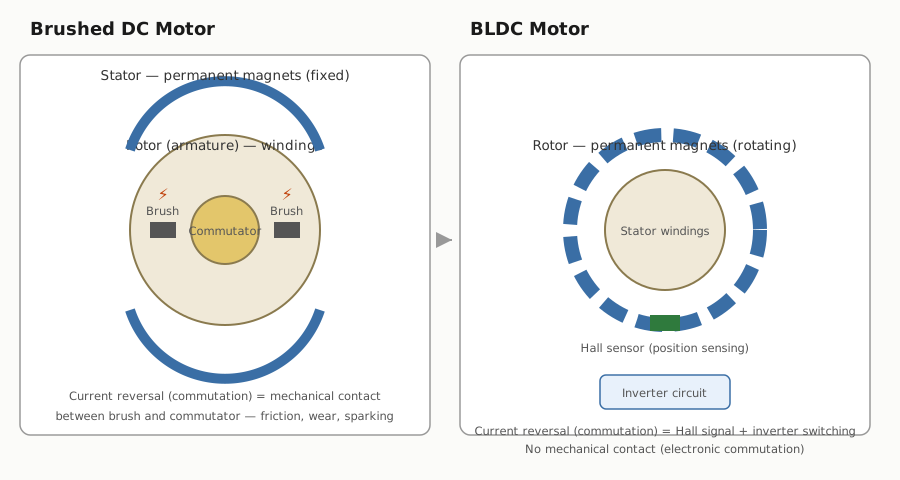
Start with the original design. A brushed DC motor has windings wrapped around a rotating shaft (the rotor, or armature), surrounded by a fixed permanent magnet (the stator). For the rotor to keep spinning, the direction of current in its windings has to flip on a schedule tied to the rotor’s position. If it doesn’t flip, the magnetic forces settle into equilibrium and the rotor simply stops.
The brush and commutator solve this reversal with physical contact. A set of metal segments (the commutator) rotates with the shaft, and carbon brushes press against it, sliding across the segments as they pass. As the rotor turns, which segment touches which brush changes, and the current direction flips automatically along with it.[1] It’s an elegant solution — no control circuit required, just mechanical geometry — but it isn’t free. The brush continuously rubs against the commutator surface, producing friction and wear, and every time contact makes or breaks, a small spark (arcing) jumps across the gap.[1] That spark generates electromagnetic interference, and the brush itself is a wear part that eventually needs replacing.
BLDC: commutation didn’t disappear — it moved into a circuit
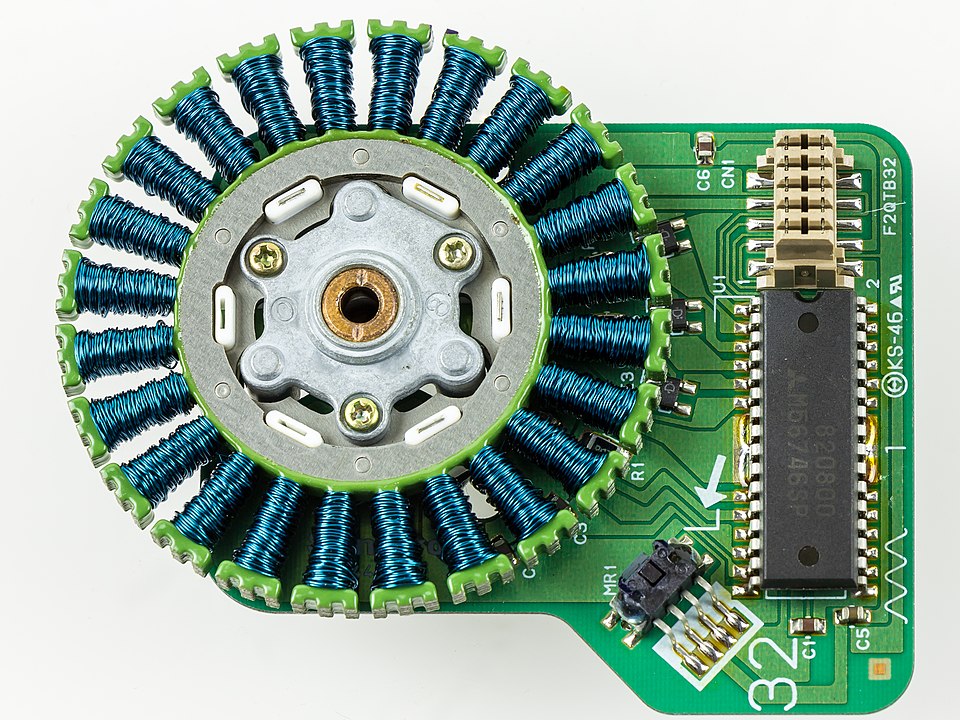
A BLDC motor’s layout is the brushed design turned inside out. The permanent magnet sits on the rotor and spins with it; the windings are fixed to the stator and never move.[2] Because the magnet and the coil have swapped places, there’s no longer any need to feed current into a spinning part through sliding contact — the stationary windings can simply be soldered to wires.
But a question remains: even with the windings fixed in place, the motor still has to know, moment to moment, which winding should be energized for the rotor’s current position. Commutation as a task hasn’t gone away. BLDC hands that task to two components instead. The first is the Hall sensor, a small semiconductor that detects the presence and orientation of a magnetic field, reporting the rotor magnet’s real-time position. The second is the inverter — a power-electronics circuit that rapidly switches transistors on and off — which uses that position data to decide, instant by instant, which winding gets current and in which direction.[3] The brush and commutator’s job has simply been inherited by the Hall sensor and the inverter. This is why the method is called electronic commutation.
Put together: “no brushes” doesn’t mean commutation stopped happening. It means the job that used to be done by mechanical contact now happens through semiconductor switching on a circuit board. The function is identical; only the part performing it changed.

The naming paradox: why does a “DC” motor spin on AC power
On to the second question. Why does a motor named for direct current sit inside an appliance plugged into an AC wall outlet?
The answer is a two-stage conversion buried inside the inverter. The circuit first rectifies the incoming AC (in the power-electronics sense: diodes convert alternating current to direct current) into a DC bus voltage. Up to this point, the current genuinely is direct current. But that DC never flows straight into the motor windings. The inverter chops it up again, switching it out to three separate winding groups (three-phase) in a sequence timed to the rotor’s position. Viewed as a waveform, this switched current looks less like a smooth square wave and more like a stepped, trapezoid-ish shape. The technique is usually called six-step commutation: one full rotation is divided into six segments, and the winding combination changes in sequence through each one to build a rotating magnetic field.[4]
In other words, the current actually driving a BLDC motor isn’t smooth DC at all — it’s closer to an artificially synthesized multi-phase AC waveform manufactured by the inverter. The name “DC motor” is largely an inherited holdover from the brushed era, when these motors really were wired straight to a battery (a genuine DC source) rather than a wall socket. The operating principle of a modern BLDC unit actually has more in common with an AC synchronous motor.
This is also where the industry’s own vocabulary starts to wobble. Motor-control technical literature typically draws the BLDC/PMSM line this way: if the back-EMF (the voltage the spinning magnet induces in the winding) is trapezoidal and the drive uses six-step electronic commutation, call it BLDC; if the current is shaped into a smooth sine wave and driven with precise vector control (Field-Oriented Control, FOC), call it a PMSM (permanent magnet synchronous motor).[4] In practice, though, that line blurs constantly. The same technical sources note that BLDC and PMSM are fundamentally the same family of synchronous machine, differing mainly in back-EMF waveform, and that real-world drive current rarely lands neatly on an ideal trapezoid or sine wave — meaning the same physical hardware can be driven either way, trapezoidal or sinusoidal.[5] “BLDC or PMSM” is a real distinction in textbooks, but the boundary that matters in practice is set by the control scheme, not the hardware. There’s no guarantee the “brushless motor” sticker on a store shelf was applied with that boundary in mind, and the gap between the label and the actual drive method is often bigger than it looks.
What removing the brush actually buys you
So what do you get in exchange for moving commutation into a circuit? Lifespan tops the list. A brush is a wear item; as it erodes, contact becomes unreliable and the motor eventually fails. Electronic commutation has no mechanical contact at all, so that entire failure mode is designed out. Second is noise, both acoustic and electrical: without brush-commutator sparking, electromagnetic noise and the associated friction sound both drop. Third is maintenance — brush replacement disappears as a scheduled service item entirely.
LG Electronics, which states it has developed BLDC motors in-house since 1993 for refrigerators, dishwashers, vacuum cleaners, and air conditioners, describes the core change plainly: the carbon brush assembly that transfers force to the motor is “replaced by an electronic circuit.”[6] That description matches exactly what the physics above shows — nothing was eliminated; it was substituted.
None of this comes free, though. A brushed DC motor will run the instant you connect it to a battery. A BLDC motor requires a Hall sensor and inverter circuit as a hard prerequisite. More circuitry means higher component cost and more design complexity than the brushed alternative — not less. “No brush” isn’t a bonus that arrives free of charge; it’s a benefit purchased with circuit cost.
Putting a number on it: how much better is the efficiency, exactly
Everything so far has been qualitative. Time for numbers. Rotating-machine efficiency has an international ratings standard: the International Electrotechnical Commission’s IEC 60034-30-1. Its first edition, published in 2014, defined efficiency classes IE1 (Standard) through IE4 (Super Premium) for induction (asynchronous) motors. A second edition published in 2025 added a new top class, IE5, and expanded the standard’s scope to single-speed AC motors generally, from 0.12 kW to 1,000 kW.[7]
IE5 is where things get interesting. Industry technical references note that IE5 is effectively unreachable without PMSM (permanent magnet synchronous motor) or SynRM (synchronous reluctance motor) technology.[8] In other words, the international standard itself has baked in an admission: putting a permanent magnet on the rotor is what buys you the top efficiency tier. As a worked example, for a 4-pole, 11 kW motor, the rated efficiency at IE4 is 93.3%, versus 95.0% at IE5.[8] That looks like a modest 1.7-percentage-point gap — but it actually represents losses (the share of input power that dissipates as heat and other waste) falling from 6.7% to 5.0%, which means the loss itself drops by nearly 25%.
That roughly 25% loss reduction is specific to the 11 kW, 4-pole example above; the baseline efficiencies for IE4 and IE5 both shift with rated output and pole count, so the percentage improvement will vary by motor size.[8]
One caveat matters here. The classes IEC 60034-30-1 defines are measured strictly at rated load (100% load).[8] The standard itself says nothing about efficiency differences under everyday partial-load conditions. And most household fans and pumps rarely run at full output — they spend the bulk of their time at some intermediate speed setting. That gap between the standard’s test condition and how appliances are actually used is exactly where intuition and reality can part ways.
General electrical-machine principles offer a directional answer. An induction motor generates its rotor magnetic field by inducing current in the rotor itself, so a meaningful resistive loss (I²R loss) from that induced current persists even as load drops. A PMSM/BLDC motor’s rotor field comes from a permanent magnet instead, so that induction-loss term doesn’t exist at all — meaning efficiency tends to hold up better as load decreases.[9] The precise magnitude of that advantage (how many percentage points) varies by model and load condition, and this fact-check couldn’t locate a reliable, standardized figure for it. So the claim here stops at direction — “holds up better under partial load” — without asserting a specific percentage.
The appliance payoff: power draw and speed control
So how much less electricity does a store-bought BLDC fan actually use compared to a same-size AC induction-motor fan? Being honest about this requires a disclosure up front: this fact-check could not find a brand-specific savings percentage backed by an official spec sheet or a public-agency certification. Most of the savings figures that surfaced in research came from retailer or marketing material, without the test conditions (fan speed setting, test method) disclosed — not solid enough to treat as a verified comparison. Rather than assert a specific percentage or wattage, the honest summary is qualitative: the savings vary substantially by product, speed setting, and test conditions.
That doesn’t mean the savings claim is baseless, though — several countries formally regulate exactly this. South Korea’s Korea Energy Agency (KEMCO) runs an efficiency-labeling program that designates household fans (20–41 cm blade diameter, table/pedestal/stand types for home or office use) as a regulated category, applying an energy-efficiency grade label and a minimum efficiency standard.[10] Products that fail to meet the minimum can’t legally be manufactured or sold domestically.[11] Comparable frameworks exist elsewhere: the US Department of Energy sets binding energy conservation standards for ceiling fans and other fan categories under 10 CFR Part 430/431, and the EU’s Ecodesign framework (Commission Regulation (EU) 2024/1834) requires fan motors from 0.12 kW to 1,000 kW to meet at least the IE2 efficiency class[15] — though the specific test methods and thresholds differ by jurisdiction. The underlying fact — that motor architecture produces a real, measurable difference in a fan’s power draw, and that regulators track it — is solid. Exactly how many percentage points a given BLDC model saves is a question for that model’s individual test certificate, not something that generalizes to “BLDC always saves X%.”
The gain that verifies far more cleanly than wattage is speed-control precision. An AC induction motor’s rotation speed is effectively locked to the line frequency and pole count, so producing finely graded speed settings requires extra phase-control circuitry or mechanical gearing. A BLDC motor, by contrast, can vary its speed continuously just by adjusting the inverter’s switching timing in real time.[3] That’s why fans marketed with ten or more distinct speed settings are overwhelmingly BLDC units. This isn’t really an efficiency story — it’s a more fundamental difference in control method, and one of the cleaner, more unambiguous advantages in this whole comparison.
The counterweight: why induction motors still sell just fine
Before concluding that BLDC simply wins across the board, it’s worth pausing on the counter-case. Walk into a factory floor and look at the large pumps, fans, and conveyors — AC induction motors are still the default there. The fact that IEC 60034-30-1 continues to treat induction motors as a core covered category is itself evidence of this.[7]
The reasons are straightforward. An induction motor needs no permanent magnet (typically a rare-earth material) on its rotor, so it’s cheaper to build; its structure is simpler and more failure-tolerant; and it can be wired straight to line-frequency AC power (line-start) with no dedicated control electronics at all. That’s the exact opposite of BLDC/PMSM, which requires a Hall sensor and inverter as a hard prerequisite. In high-power, cost-sensitive applications, the price of moving commutation into a circuit can outweigh the efficiency and noise benefits. “Brushless always wins” isn’t the right takeaway — the right one is that the answer depends on scale and application.
Where these motors actually show up: appliances to drones
The pattern gets clearer once you look at where BLDC and other electronically commutated motors actually get used. In home appliances, they show up well beyond fans and air purifiers — air conditioner compressors and refrigerator compressors both use them widely. LG Electronics describes applying an “inverter linear compressor” to its refrigerators, where the motor itself moves in a straight line rather than converting rotary motion to linear motion through a reciprocating mechanism — a design that’s itself a variation on the brushless, electronically commutated motor.[12] Move to smaller devices, and brushless motors are standard in cordless vacuums and power tools from brands like Dyson, Makita, and DeWalt. Power tools, which run directly off a battery (a genuine DC source), are actually the application closest to what the name “BLDC” originally described.
Outside appliances entirely, a hard drive’s spindle motor is a textbook three-phase brushless design — a platter that has to spin at a constant speed continuously all but requires a mechanism with no wear-prone contact.[13] Drones land on brushless motors as the de facto standard for the same reason: they need battery power, low weight, and fast response all at once.
Electric-vehicle traction motors deserve careful handling here, though. “EV motors are BLDC too” is a common oversimplification, and the reality varies by model. Tesla’s Model 3 uses a permanent-magnet synchronous design (IPM-SynRM); the Model S uses an induction motor with no permanent magnet at all, generating its rotor field by induction instead. Hyundai and Kia’s Ioniq 5 and EV6 use drive motors from Hyundai Mobis that fall in the permanent-magnet synchronous motor (PMSM) family.[14] The EV industry’s mainstream choice, in other words, sits much closer to PMSM (and sometimes plain induction) than to anything labeled BLDC. Treating BLDC as the flagship example of EV motor technology overstates the case.
FACT
“No brushes” doesn’t mean commutation went away. It’s still happening every instant the motor runs — the job just moved from mechanical contact between a brush and a commutator to an electronic circuit built from a Hall sensor and an inverter.[1][2][3] Despite the “DC motor” name, the current actually flowing through the windings is a multi-phase, inverter-synthesized waveform, closer to trapezoidal AC than smooth direct current — which is exactly why it can shrug off a wall socket’s alternating current without any contradiction.[4] Even the industry can’t cleanly agree where BLDC ends and PMSM begins, which says something about how loosely a three-letter sticker on a store shelf is actually applied.[5]
In exchange for moving commutation into a circuit, wear, noise, and maintenance burden genuinely drop, and the top tier of the international efficiency standard is effectively unreachable without a permanent-magnet rotor.[7][8] But that circuit has to exist, and in high-power, cost-driven industrial settings, induction motors still hold the standard position.[7] Next time you spot a brushless sticker with a markup attached, it’s more accurate to read it not as a promise of some fixed percentage of saved electricity, but as the price tag for a commutation circuit that moved from a mechanical part onto a circuit board.
References
[1]: Microchip Technology, “AN885: Brushless DC (BLDC) Motor Fundamentals” — explains mechanical commutation via commutator and brush contact in brushed DC motors, and the friction, wear, and sparking that contact produces. https://ww1.microchip.com/downloads/en/appnotes/00885a.pdf
[2]: Microchip Technology, “AN885: Brushless DC (BLDC) Motor Fundamentals” — BLDC motor structure: permanent-magnet rotor and wound stator, the inverse of a brushed DC motor’s magnet/winding placement. https://ww1.microchip.com/downloads/en/appnotes/00885a.pdf
[3]: Microchip Technology, “AN885: Brushless DC (BLDC) Motor Fundamentals”; ISL Products, “Brushless Motor Control Overview” — Hall-sensor-based rotor position sensing and inverter switching as electronic commutation; continuous speed control. https://ww1.microchip.com/downloads/en/appnotes/00885a.pdf ; https://islproducts.com/design-note/brushless-motor-control-overview/
[4]: Bacancy Systems, “Differentiating Trapezoidal & Sinusoidal BLDC motors” — the standard distinction between trapezoidal (six-step) commutation and sinusoidal (FOC) commutation, and the conventional BLDC/PMSM boundary. https://bacancysystems.com/blog/trapezoidal-and-sinusoidal-bldc-motors
[5]: Volcano Electric, “BLDC vs PMSM: Which One is Better for Your Application?” — explains that BLDC and PMSM belong to the same synchronous-machine family and differ mainly in back-EMF waveform, and that real drive current often departs from an ideal trapezoid or sine wave, meaning identical hardware can be driven either way. https://www.volcanomotors.com/bldc-vs-pmsm-which-one-is-better-for-your-application/
[6]: NextDaily, “LG Electronics’ 55 Years of Craftsmanship: The Motor and Compressor Heart of Home Appliances” — LG Electronics’ own account of developing BLDC motors since 1993 for refrigerators, dishwashers, vacuum cleaners, and air conditioners, describing the change as replacing “the brush assembly that transfers force to the motor” with an electronic circuit. https://www.nextdaily.co.kr/news/articleView.html?idxno=22087
[7]: IEC (International Electrotechnical Commission), “IEC 60034-30-1:2025 — Rotating electrical machines - Part 30-1: Efficiency classes of line operated AC motors (IE code),” 2nd edition — supersedes the 2014 first edition, introduces the IE5 class, and specifies scope as single-speed AC motors (including induction motors) from 0.12 kW to 1,000 kW. https://webstore.iec.ch/en/publication/91195
[8]: Technische Antriebselemente, “IE efficiency classes IE1 to IE5: Guide for designers” — states IE5 is effectively achievable only with PMSM/SynRM technology; gives the worked example of a 4-pole, 11 kW motor at IE4 rated efficiency 93.3% vs. IE5 95.0%; and specifies that IEC 60034-30-1 classes are defined only at 100% rated load (partial-load behavior is a separate matter). https://technische-antriebselemente.de/en/guides/ie-efficiency-classes-motors/
[9]: Qualitative explanation grounded in general electrical-machine theory — induction motors retain a meaningful I²R loss from rotor-induced current even under partial load, while PMSM/BLDC motors, using permanent-magnet excitation, lack this loss term entirely, giving them a comparatively gentler efficiency drop-off at partial load. Kinghike, “PMSM vs Induction Motor: Which is Better for Your Application?” https://www.kinghike.com/comparison-of-permanent-magnet-synchronous-motors-pmsms-and-induction-asynchronous-motors.html
[10]: Korea Energy Agency (KEMCO), efficiency-management program overview — designates household/office fans (20–41 cm blade diameter; table, pedestal, and stand types) as a regulated category under the Efficiency Management Equipment program, applying an energy-efficiency grade label. https://eep.energy.or.kr/business_introduction/effi_standard.aspx
[11]: Ministry of Climate, Energy and Environment (formerly Ministry of Trade, Industry and Energy), Republic of Korea, “Operating Regulations for Efficiency Management Equipment” notice — bans domestic manufacture and sale of products that fail to meet the minimum efficiency standard. Linked here is the Korea Energy Agency’s archive listing page where the amended notices are posted; the specific clause requires checking the individual notice in that archive. https://eep.energy.or.kr/pds/list.aspx
[12]: LG Electronics, “LG’s ‘Linear Motion’ Inverter Linear Compressor Now Applied Across LG’s Entire Refrigerator Lineup” — describes an inverter linear compressor, in which the motor itself moves in a straight line rather than through a reciprocating mechanism, applied to refrigerators. https://www.lg.co.kr/media/release/7584
[13]: HDD Surgery, “HDD Spindle Motor” — explains that a hard drive’s spindle motor is a brushless DC motor design, with an inverter replacing the traditional mechanical commutator to control stator winding current, using rotor position sensing to time inverter operation (older models use a dedicated position sensor; newer models more often sense back-EMF from an unenergized winding, per supplementary discussion in the article’s comments). https://hddsurgery.com/blog/hdd-spindle-motor
[14]: HelloT, “Is an EV’s Heart Really Its Battery?” — reports that Tesla’s Model 3 uses an IPM-SynRM (permanent-magnet-assisted synchronous motor), the Model S uses an induction motor, and Hyundai/Kia’s Ioniq 5 and EV6 use Hyundai Mobis drive motors in the permanent-magnet synchronous motor (PMSM) family. https://www.hellot.net/mobile/article.html?no=63472
[15]: US Department of Energy, energy conservation standards for ceiling fans and other fan/blower equipment, codified at 10 CFR 430.32(s) and 10 CFR Part 431; European Commission, Ecodesign for Fans — Commission Regulation (EU) 2024/1834, requiring fan motors from 0.12 kW to 1,000 kW to meet at least the IE2 efficiency class — added for global-edition context on regulatory frameworks comparable to KEMCO’s. https://www.energy.gov/cmei/buildings/ceiling-fans ; https://energy.ec.europa.eu/news/commission-sets-new-ecodesign-rules-industrial-fans-2024-07-03_en